AI agent pricing looks straightforward until hidden fees, per-call charges, and token limits start consuming budgets faster than expected. Many teams run into this problem when evaluating Application Modernization Tools: the advertised cost rarely reflects what a real workload actually demands. Understanding how pricing models are structured, what drives costs up or down, and how to match a plan to specific usage patterns is the clearest path to avoiding overspend.
Knowing the pricing structures is only part of the equation. Accurate cost forecasting requires visibility into cost per task, agent deployment limits, and integration options before any commitment is made. Teams looking for that kind of transparency can find a practical starting point with CodeGiant's enterprise AI platform, which ties pricing directly to usage and makes it easier to plan at scale.
Table of Contents
- What Is AI Agent Pricing, and How Does It Work?
- What Factors Affect AI Agent Pricing?
- Why Does AI Agent Pricing Vary Between Vendors and Pricing Models?
- When Should Your Business Invest in an Enterprise AI Agent Platform?
- 9 Ways Enterprise Teams Can Reduce AI Agent Costs Without Sacrificing Performance
- How CodeGiant Helps Enterprise Teams Build Cost-Effective AI Agents
- Try CodeGiant's Enterprise AI Platform Today
Summary
- AI agent pricing operates across three core structures: per-seat, usage-based, and outcome-based models. Each one places financial risk differently, and the familiar approach of choosing a plan based on pilot costs rarely holds once agents connect to more systems, retry failed steps, and trigger cascading tool calls. According to Nevermined, the shift toward consumption-aligned billing is accelerating as organizations move agents from sandboxed experiments into live production environments where uncontrolled spend becomes a governance problem.
- Agent autonomy is one of the most underestimated cost drivers in production deployments. Token consumption for agentic workflows can be 5x to 10x higher than single-turn LLM interactions according to DataGrid's AI Agent Statistics, meaning the moment a team moves from a simple chatbot to a reasoning agent, the cost baseline shifts dramatically before a single user touches it. Choosing a cheaper model per token does not automatically mean cheaper per outcome once retries and context growth are factored in.
- Integration depth adds cost in two directions at once: setup and runtime. Every tool call to an external system consumes tokens for planning, parameter generation, result parsing, and error handling. A single failed API call triggering three automatic retries can quadruple the cost of one workflow step, and in a multi-system workflow with five or six integration points, those retries stack quickly.
- Compliance requirements create a cost layer that sits entirely outside the model pricing conversation. DataGrid reports that enterprise AI agent deployments can require 40% more compute resources than standard deployments due to multi-step reasoning and tool use, and compliance layers for audit logging, encryption, access controls, and human approval gates push that figure higher. Most organizations discover this premium only after the first production invoice rather than during planning.
- Vendor pricing differences reflect each vendor's cost structure and risk tolerance, not just feature differentiation. Per-resolution pricing for comparable AI customer service outcomes ranges from $0.50 to $2.00 across vendors according to Quickchat AI, and Nevermined reports that AI agent pricing varies by up to 10x between vendors for similar capabilities. Outcome-based pricing, often seen as the cleanest solution, carries its own complexity: BCG survey data shows that 47% of buyers cannot yet define clear measurable outcomes, and 36% cite cost predictability as a top concern even within outcome-based structures.
- Governance is where cost control either holds or collapses in production. An agent without explicit workflow branches, human-in-the-loop checkpoints, and defined operational bounds will run unlimited model calls until someone notices the bill. PwC's AI Agent Survey reports that 51% of executives cite cost reduction as a top expected benefit of AI agents, but achieving that requires a cost structure built into the agent architecture from day one, not retrofitted after the first invoice shock.
- CodeGiant's enterprise AI platform addresses this directly by combining governed workflows, built-in observability, and deterministic execution controls so teams can forecast cost per task before committing to production rather than after the bill arrives.
What Is AI Agent Pricing, and How Does It Work?
Clear, scalable pricing might seem like the end goal. It isn't. It's the beginning.
"Pricing clarity is not the destination: it's the foundation on which sustainable AI deployment is built." — Industry Insight
💡 Why This Matters: Understanding AI agent pricing from the start prevents costly surprises later. What appears as a simple cost structure often masks layers of variable expenses that compound quickly.

AI agent pricing determines exactly what you pay to build, deploy, and run autonomous agents in production environments. Unlike a SaaS seat license — which stays flat no matter how much you use it — agent costs change based on a set of dynamic factors that shift with every interaction.
🎯 Key Point: Agent pricing is consumption-based, not fixed. Every action your agent takes potentially affects your bill.
Pricing Factor |
What It Means |
|---|---|
What the agent does |
Task complexity drives compute and token usage |
How often it does it |
Frequency scales your costs up or down |
Which models it uses |
Premium models cost significantly more per call |
Whether it works |
Failed runs may still incur partial charges |
⚠️ Warning: Treating AI agent pricing like a traditional SaaS subscription is one of the most expensive mistakes teams make when scaling autonomous workflows.
What are the primary AI agent pricing structures?
AI agent pricing has three main structures: per-seat, usage-based, and outcome-based. Per-seat pricing gives finance teams predictable costs and works best for continuous, broad workloads. Usage-based pricing measures every tool call, document processed, or token used, keeping spending proportional to activity but requiring real-time dashboards to prevent unexpected bills. Outcome-based pricing charges only when the agent delivers a verified result—a resolved ticket, qualified lead, or closed case—creating the strongest connection between cost and value but requiring clear contractual rules before the agent begins work.
Why does AI agent pricing break down as volume grows?
Most teams start with the safest model, then discover it doesn't fit once volume grows. Agents connect to more systems, retry failed steps, and trigger cascading tool calls that the original pricing model never accounted for. A single customer-visible outcome can generate dozens of internal API calls, and without a metering layer that abstracts that complexity, invoices become hard to read. Our enterprise AI platform CodeGiant addresses this by tying agent deployment to transparent usage tracking and integration controls, enabling organizations moving from experimentation into production to forecast cost per task before committing.
How do hybrid models make AI agent pricing more predictable?
Hybrid models have emerged as the practical middle ground for most enterprise deployments. A base platform fee covers fixed infrastructure and a defined action allowance; overages or verified outcomes trigger variable charges. This structure gives budget owners a predictable floor for planning while allowing vendors to earn proportionally when agents handle heavier workloads. The metering layer must send real-time events tied to state transitions, tool completions, and final status codes so the billing system can convert raw agent activity into invoice line items. PwC's survey found that 79 percent of companies already report some form of AI agent adoption, meaning more organizations now need these metering and control mechanisms in live production.
Why is AI agent pricing a governance decision, not just a financial one?
Pricing decisions in enterprise AI aren't merely financial—they're governance choices. Choosing a model without real-time throttling, soft caps, or audit-ready billing events means accepting an uncontrollable system at scale. For organizations in financial services, healthcare, or government, that tradeoff is unacceptable. The pricing structure you choose reveals whether the platform was built for demos or production. Knowing which model fits your workload is only one part of the decision. The variables that drive your costs are far less obvious than the pricing page suggests.
Related Reading
- Application Modernization Tools
- What Is Application Modernization
- How To Modernize Legacy Systems
- Build Internal Tools
- Cobol Modernization
- Mainframe To Cloud Migration
- Legacy Software Modernization
- Cobol To Java
- Technical Debt Management
- Ai Governance
- Legacy System Modernization
What Factors Affect AI Agent Pricing?
The things that affect how much your AI agent costs aren't shown on pricing pages. Instead, they come from the technical choices your team makes before and after you launch the AI agent. These hidden cost drivers add up quietly until you get your bill.
"The real cost of an AI agent isn't the sticker price — it's the accumulation of technical decisions made long before launch day." — Industry Insight
💡 Tip: Before committing to any AI agent platform, map out your technical requirements — things like model complexity, API call volume, and integration depth — so hidden costs don't catch you off guard.
⚠️ Warning: Pricing pages rarely reflect your actual bill. The true cost is shaped by the choices your team makes during setup, configuration, and ongoing operation — not the base rate you see advertised.
Cost Factor |
Why It Matters |
|---|---|
Model complexity |
More advanced models = higher per-call costs |
API call volume |
More interactions = faster spend accumulation |
Integration depth |
Complex setups require more engineering time |
Post-launch tuning |
Ongoing adjustments add to total cost |

How does agent autonomy drive up AI agent pricing at every decision point?
Agent autonomy is the most underestimated cost driver in production deployments. An agent answering a single question pulls one inference and stops. An agent planning multi-step workflows, selecting tools, handling exceptions, and looping until a goal is met generates cascading model calls at every decision point. The same business outcome—resolving a support ticket or processing a loan application—can cost pennies in a controlled demo and several dollars in production, depending on how many branches the agent explores.
According to DataGrid's AI Agent Statistics, token consumption for agentic workflows can be 5x to 10x higher than single-turn LLM interactions. Moving from a simple chatbot to a reasoning agent shifts your cost baseline dramatically before deployment.
How does model choice compound AI agent pricing beyond unit token rates?
The choice of underlying model complicates this problem further. Frontier models charge higher rates per token and deliver stronger reasoning, but lighter models often require more attempts or larger context windows to achieve comparable output quality, resulting in higher total costs despite lower unit prices. Cheaper-per-token rarely means cheaper-per-outcome once you account for retries and context growth.
Why integration depth raises the price per completed workflow
Every outside system your agent connects to adds cost in two ways: setup and runtime. Each tool call—whether to a CRM, payment gateway, or legacy database—uses tokens for planning, parameter generation, result parsing, and error handling. Failed API calls trigger automatic retries that immediately multiply costs. A single failed call with three retries quadruples that step's cost; in a multi-system workflow with five or six integration points, retries compound quickly.
How does production volume change AI agent pricing for integrated workflows?
Most teams build integrations step by step during pilots, where traffic is low and failures are rare. This approach breaks at production volume, where concurrent sessions, longer conversation histories, and higher failure rates converge. Our enterprise AI platform at CodeGiant provides deterministic automation controls and enterprise-grade governance, enabling integration depth to scale without turning production incidents into uncontrolled cost events.
The compliance premium nobody budgets for in advance
Industries with strict regulations incur additional costs beyond base pricing. Logging agent activity, protecting data in transit and at rest, controlling access, maintaining human approval loops, and meeting HIPAA or GDPR requirements all demand extra infrastructure and per-action costs. These requirements raise both base platform fees and marginal costs per workflow step. Most organizations discover this premium only after the first production invoice. DataGrid's AI Agent Statistics report that enterprise AI agent deployments require 40% more compute resources than standard deployments due to multi-step reasoning and tool use, with compliance layers pushing that figure higher.
How does AI agent pricing shift after the initial deployment phase?
Ongoing monitoring, drift detection, and human-in-the-loop escalations incur costs beyond initial deployment. Each escalation requires spending on model operations and labor to resolve issues. Without tools that track spending per workflow step, these costs remain hidden until the monthly bill arrives.
Why Does AI Agent Pricing Vary Between Vendors and Pricing Models?
Vendor pricing differences reveal how each vendor organizes costs, their exposure to margin risk, and how willing they are to take on uncertainty for you.
"The way a vendor structures their pricing is a direct signal of where they absorb risk — and where they pass it on to you." — Pricing Strategy Insight
🎯 Key Point: Pricing structure isn't just about cost — it reflects how a vendor manages their own operational risk and whether that risk is shared with or shifted onto the buyer.
⚠️ Warning: Never evaluate AI agent pricing on sticker price alone. The real cost lies in understanding margin risk exposure, hidden usage thresholds, and how much pricing uncertainty you inherit as the customer.
Pricing Factor |
What It Reveals |
|---|---|
Cost organization |
How the vendor structures internal expenses |
Margin risk |
Where financial uncertainty sits — with vendor or buyer |
Willingness to absorb uncertainty |
How much risk the vendor shields you from |

How does inference cost variability shape AI agent pricing across vendors?
The main reason is inference cost variability. BCG research on B2B software pricing documents one customer-engagement vendor experiencing margin variance exceeding 70 percentage points across accounts due to different model usage intensities. A vendor absorbing that swing cannot offer a flat rate without losing money on heavy users or overcharging light ones. Since every vendor's cost curve differs based on which models they run, context caching, and inference optimization, pricing structures diverge significantly.
Why do autonomous agents make fixed-fee AI agent pricing models unsustainable?
McKinsey shows that economics work differently once agents operate autonomously. Because large language models don't retain information between steps, agents must resend the same growing information at every step. Agentic tasks use roughly 1,000 times more tokens than simple code-reasoning or chat interactions. This difference makes token cost a major operating expense and explains why pure fixed-fee models fail to scale: the bill rises much faster than user growth.
What does this mean for enterprise buyers?
Choosing a pricing model is a governance decision, not a purchasing one. Most enterprise teams connect vendor pricing to their existing SaaS budget frameworks, treating AI agent spending like a software license with a set spending limit. This breaks down when agentic workflows run longer loops than expected, context windows grow across multi-step tasks, and invoices arrive with unplanned charges.
The problem isn't the vendor's pricing page—it's the lack of tools to track spending between workflow and bill. Platforms like CodeGiant address this by providing clear controls and visibility, enabling enterprises to move AI agents from experimental deployments into production systems where cost behavior is observable, attributable, and governable before becoming a financial surprise.
Why outcome-based pricing is harder than it looks
Outcome-based pricing sounds ideal: you pay only when the agent succeeds, aligning vendor incentives with buyer results. However, 47 percent of buyers cannot define clear measurable outcomes, and 36 percent cite cost predictability as a top concern even with outcome-based structures.
How does attribution complexity shape AI agent pricing risk?
The core problem is attribution complexity. When an agent solves a support ticket after a person reviews it, who gets the credit? When an agent speeds up a loan approval, how much success comes from the model versus the data pipeline? Vendors must draw that line somewhere, and their choice determines whether the model protects you or puts you at risk.
What does risk transfer reveal about your vendor's confidence?
No pricing model is structurally neutral. Each transfers risk in a specific direction, revealing what the vendor is confident about and what they are not. Understanding that asymmetry before signing is essential.
Related Reading
- As400 Modernization
- Enterprise Ai Governance
- Public Sector Digital Transformation
- Mendix Alternatives
- Appian Alternatives
- Ai Agent Pricing
- Outsystems Vs Mendix
- Outsystems Alternatives
When Should Your Business Invest in an Enterprise AI Agent Platform?
Invest in an enterprise AI agent platform when your existing tools can't handle your business's complexity, scale, and security requirements—not just because AI becomes popular. If your team spends more time managing disconnected solutions than delivering results, our CodeGiant platform becomes a smart investment.
"The right time to invest in an enterprise AI agent platform is when tool complexity outpaces productivity—when managing your stack costs more than the value it creates." — Enterprise AI Adoption Insight
🎯 Key Point: Don't invest in an enterprise AI agent platform because of hype—invest when your current tools fail to scale with your business's real demands.
⚠️ Warning: If your team is constantly context-switching between disconnected solutions, you're already paying a hidden productivity tax that compounds over time.
Situation |
Action |
|---|---|
Tools can't handle business complexity |
Time to invest in enterprise AI |
Team manages disconnected solutions |
CodeGiant platform adds immediate value |
Scaling security requirements are unmet |
Prioritize enterprise-grade AI infrastructure |
AI adoption driven by hype alone |
Wait — assess real business needs first |

Processes Demand Multi-Step Judgment Across Systems
Invest when core workflows require the system to read information, evaluate options, choose tools, check results, and adapt in real time. Fixed scripts handle straightforward tasks; agents excel when the sequence cannot be mapped as a static flowchart and the path shifts based on real-time discoveries. Customer support triage, expense processing spanning policy checks and multiple finance systems, and recruitment flows moving from resume review to outreach and scheduling exemplify this pattern. The platform supplies the planning layer, tool calling, and memory needed to execute variable paths reliably.
Existing Systems Already Exchange Data Reliably
A platform investment makes sense only after underlying applications can communicate through stable APIs or integrations. Agents inherit every fragmentation problem the business already has. When order systems, CRMs, knowledge bases, and approval tools support consistent data movement, agents can move across them without constant human intervention. Without that foundation, the platform multiplies integration failures. Maturity here turns the agent layer into an amplifier rather than a source of friction.
Clear Ownership and Decision Authority Already Exist
Deploy when the organization can name who owns each process outcome and who holds final authority for exceptions. Agents act on behalf of the business, so unclear human decision rights become a significant risk. Teams that already keep records of important human choices, define escalation paths, and assign named process owners can extend those controls to agents. Without that clarity, every agent action creates accountability gaps that governance frameworks later struggle to close.
Governance Frameworks Are Ready to Constrain Autonomy
The right moment arrives once the company establishes guardrails, logging, and permission boundaries before the first agent goes live. Enterprise platforms assume the business will define what an agent may access, what actions require human confirmation, and how failures surface. Organizations that treat AI outputs as decisions requiring review, version control, and rollback capability are prepared.
Leadership Views Agents as Operational Capacity, Not Side Projects
Investment pays off when executives treat agents as scalable digital labor that integrates with existing operating models. This shifts budgeting, success metrics, and change management from isolated pilots to sustained platform ownership. Teams design processes where agents handle repetitive cognitive work while humans maintain oversight and manage exceptions. The platform becomes infrastructure rather than temporary tools.
Foundational automation is already delivering value
Companies gain the most benefit from a platform after rule-based automation and basic AI assistants have reduced simpler tasks. That earlier experience reveals the remaining work involving multiple systems and requiring good judgment—work that agents are built to handle. It also helps teams improve their understanding of data quality, monitoring, and continuous improvement. Jumping straight to full agent platforms without that foundation often leaves teams managing complexity they are not yet ready for.
How does operational readiness shape AI agent pricing decisions?
The decision comes down to whether your business is ready to use it, not whether the technology is new. When a company has connected systems, clear ownership, good governance, and processes that require smart, multi-step execution, an enterprise AI platform becomes necessary infrastructure.
9 Ways Enterprise Teams Can Reduce AI Agent Costs Without Sacrificing Performance
Reducing AI costs doesn't mean limiting agent capabilities. The biggest savings come from designing smarter workflows, selecting the right infrastructure, and managing AI resources efficiently. Enterprise teams that optimize their AI architecture lower operating costs while maintaining speed, accuracy, and reliability at scale.
"The biggest savings come from designing smarter workflows, selecting the right infrastructure, and managing AI resources efficiently — not from cutting agent capabilities."
💡 Tip: Before slashing AI budgets, audit your workflow design first — most enterprise teams find their largest inefficiencies hiding in architecture decisions, not model selection.
🎯 Key Point: Cost optimization and peak performance are not mutually exclusive. The 9 strategies below show enterprise teams how to achieve both simultaneously — reducing overhead without sacrificing the speed, accuracy, or reliability your operations depend on.
Cost Driver |
Optimization Strategy |
Expected Impact |
|---|---|---|
Workflow Design |
Smarter agent task routing |
High |
Infrastructure Selection |
Right-sized model deployment |
High |
Resource Management |
Efficient AI resource allocation |
Medium–High |
Architecture Decisions |
Optimized AI system design |
High |

1. Route Each Step to the Right Model Tier
Most agent workflows mix simple classification or extraction with occasional complex reasoning. Build a routing layer that inspects task type or confidence and directs lightweight work to efficient models while reserving stronger ones for planning, ambiguous decisions, or final synthesis. This preserves output quality because hard steps still receive full capability, yet routine calls no longer drive most costs.
2. Cache Stable Prompt Prefixes
Agents repeatedly send the same system instructions, tool schemas, and base policies. Major providers support prompt caching, which stores these static blocks after the first call and reuses them at lower cost on subsequent requests. Apply caching to every stable prefix so the agent pays the full price only once per session or per unique context, while dynamic user messages and recent history flow through normally.
3. Compress Context Before Every Call
Long conversation histories and large tool responses increase input tokens. Summarize or use a sliding-window approach to retain only important information, recent decisions, and relevant facts before each model call. Remove earlier turns that no longer affect the current goal. This maintains agent performance while reducing context size, lowering costs and improving response speed.
4. Cap Iterations and Tool Retries
Agents without limits can get stuck in loops, retry failed tools repeatedly, or pursue endless improvements. Set clear maximum iteration counts and retry limits for each tool in the agent runtime. Add detection for nearly identical consecutive calls so the system stops and escalates or falls back instead of wasting tokens. These limits prevent runaway spending while allowing sufficient steps for legitimate multi-step work.
5. Batch Non-Urgent Workloads
Send non-urgent agent tasks—such as overnight report generation, bulk classification, and scheduled enrichment—through batch interfaces offered by model providers. Batch processing uses the same models and quality levels but processes during off-peak hours at lower costs. Real-time paths continue using synchronous calls, so user-facing latency remains unchanged while background volume costs decrease.
6. Prune Tool Definitions and Outputs
Agents often load long lists of tool schemas and wordy API responses. Cut tool descriptions to minimum required fields and configure tools to return only essential data. Filter intermediate results before returning them to the prompt. The reasoning path remains complete because the model receives the facts needed for correct action, while each call uses fewer tokens.
7. Enforce Per-Agent Spending Guardrails
Runtime limits control costs by setting hard token or dollar budgets for individual agents or workflows. When spending reaches these limits, the system automatically slows down or alerts someone. Use these controls alongside real-time tracking so teams can identify which steps cost the most and adjust routing or context rules quickly. Performance remains unchanged because guardrails operate outside the reasoning loop, allowing agents to run normally until hitting the spending limit.
8. Cache Tool Results and Semantic Responses
When you call the same tool multiple times for the same information—such as customer records, policy lookups, or inventory status—you incur unnecessary charges. Save recent tool outputs with short time-to-live values and reuse them when the underlying information hasn't changed. You can also use semantic caching so similar user requests return a previously generated answer instead of running the full agent again. The agent works with current information while avoiding duplicate work.
9. Build Efficient Agents Directly on Existing Systems
The cleanest long-term reduction comes from platforms that let teams generate production-grade agents and workflows on top of existing systems rather than stitching together separate tools. Our Agent Builder and Workflow Builder turn prompts into governed agents connected to the enterprise stack, complete with an Embedded IDE for last-mile control and one-click deployment. Since agents run with full compliance and reliability against systems the business already trusts, teams avoid duplicate integrations and uncontrolled experimentation while delivering required performance.
How CodeGiant Helps Enterprise Teams Build Cost-Effective AI Agents
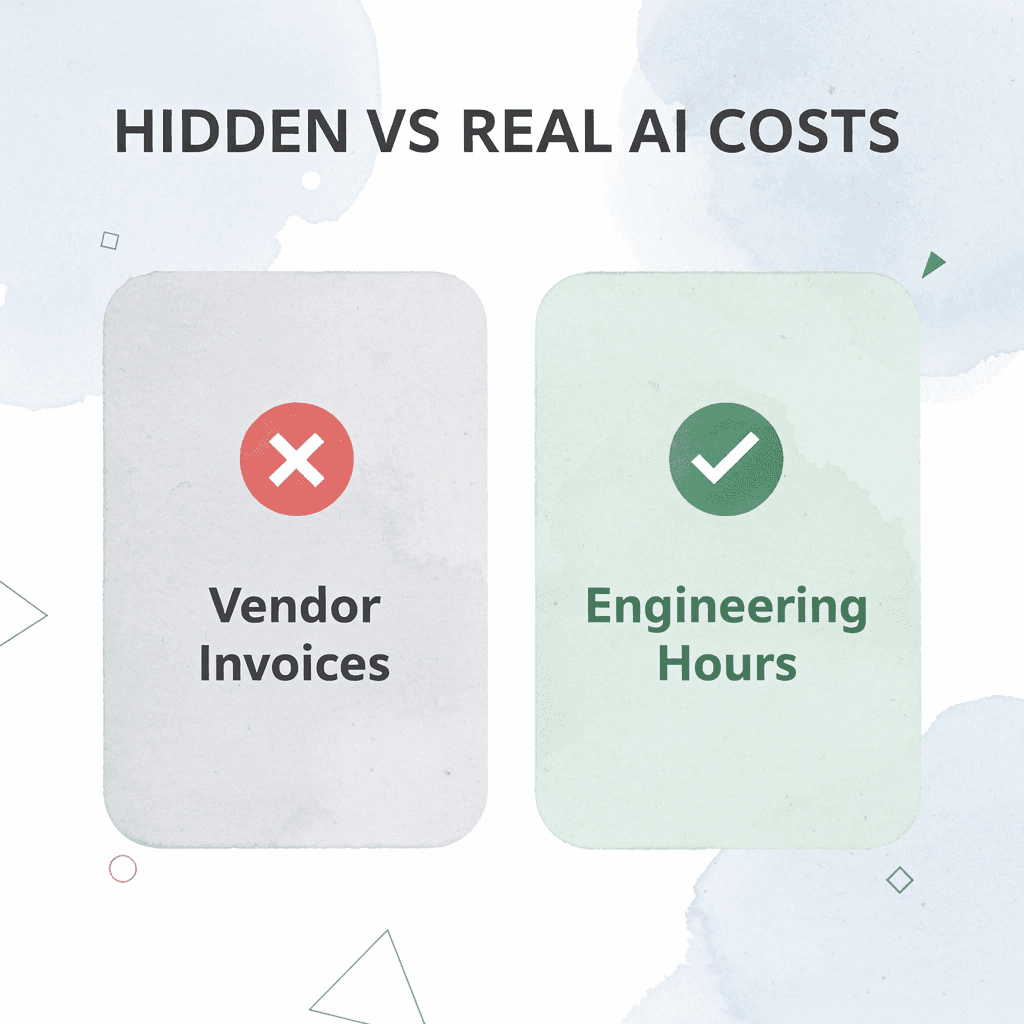
The real cost of AI agents in production rarely shows up in vendor invoices. It shows up in engineering hours spent fixing sync failures, emergency model switches after unreliable deployments, and token waste when agents repeat context across disconnected systems. Those costs add up fast.
"The hidden costs of AI in production — sync failures, emergency model switches, and token waste — accumulate far beyond what any vendor invoice reveals."
💡 Tip: Before evaluating any AI agent platform, audit your actual cost drivers — engineering time, token overhead, and deployment reliability are often far more expensive than licensing fees.
⚠️ Warning: Teams that optimize only for upfront vendor pricing routinely underestimate the true total cost of running AI agents at scale — hidden operational expenses can dwarf the original contract value.
Hidden Cost Category |
Root Cause |
Business Impact |
|---|---|---|
Engineering Hours |
Fixing sync failures & integration bugs |
Lost productivity, delayed releases |
Emergency Model Switches |
Unreliable deployments & vendor instability |
Unplanned downtime, scrambled teams |
Token Waste |
Repeated context across disconnected systems |
Inflated API bills, degraded performance |
🎯 Key Point: CodeGiant is built to eliminate exactly these hidden cost drivers — delivering reliable deployments, seamless system integration, and token-efficient architecture so enterprise teams stop paying the invisible tax of poorly connected AI infrastructure.
Why do fragmented tool stacks drive up AI agent pricing?
Most teams assemble point solutions: one tool for organizing, another for deployment, a separate IDE for edits, and another for legacy system access. Every boundary between tools becomes a cost center—context repeats, authentication layers multiply, and engineering teams spend more time maintaining connections than improving agents. AI agents can handle up to 80% of routine enterprise tasks independently, but that assumes a stable, integrated production environment, not constant infrastructure rescues.
The failure point is the gap between where an agent was built and where it runs. An agent prototyped against a clean API behaves differently when it hits a 30-year-old COBOL ledger, a Salesforce org with custom objects, or undocumented Zendesk instances. Teams that build on platforms designed to close that gap spend token budgets on business logic instead of plumbing repairs. CodeGiant lets teams create production-grade agents on existing systems, with the Harness Engine managing integrations so compute goes toward outcomes rather than connection overhead.
How does governance determine whether AI agent pricing stays predictable?
Governance is where cost control works or fails. An agent without clear workflow branches, human-in-the-loop checkpoints, and operational limits will make unlimited model calls until someone notices the bill. PwC's AI Agent Survey reports that 51% of executives cite cost reduction as a top expected benefit of AI agents, but cost reduction requires governance built into agent architecture from the start, not added after the first invoice.
Enterprises that achieve lasting cost efficiency treat pricing model selection and platform architecture as one decision. Choosing usage-based pricing on a platform where agents lack guardrails is like negotiating fuel efficiency on a vehicle with no speedometer. When agents run inside governed workflows with clear branches, timeout rules, and escalation paths, per-token or per-outcome costs become predictable because agent behavior is predictable. That predictability separates cost-effective deployments from those that merely started cheap.
What does it actually cost when an AI agent runs wrong?
The question most enterprise teams ask too late is not "what does this agent cost to run?" but "what does it cost when it runs wrong?" Unreliable agents create hidden operating expenses: monitoring cycles, manual rescues, and rollback decisions at 2 a.m. Getting governance architecture right before the first production deployment is the only cost control that works under real enterprise load.
Related Reading
- Enterprise Architecture Modernization
- Rpg Modernization
- Iseries Modernization
- Application Modernization Benefits
- .net Modernization
- Application Modernization Roadmap
- Cobol Replacement
- Insurance Legacy Modernization
Try CodeGiant's Enterprise AI Platform Today
Adding another AI tool to a fragmented stack makes AI agent pricing complexity worse instead of better. The real cost problem — structural, spanning token consumption to governance overhead — stays the same no matter which model you choose or how carefully you read a vendor's pricing page. If your team is putting together separate orchestration, deployment, monitoring, and integration layers, billing surprises will keep happening.
"The real cost problem is structural — spanning token consumption to governance overhead — and it stays the same no matter which model you choose or how carefully you read a vendor's pricing page."
⚠️ Warning: Stitching together point solutions for orchestration, deployment, monitoring, and integration doesn't reduce cost complexity — it multiplies it. Every new layer is another billing variable you don't control.
Fragmented Stack Problem |
What It Costs You |
|---|---|
Separate orchestration layer |
Unpredictable token overhead |
Disconnected monitoring |
Blind spots in cost visibility |
DIY integration layers |
Engineering time + governance risk |
Experimentation tools in production |
Billing surprises at scale |
CodeGiant brings those layers together in a single enterprise platform. Our platform helps developers build production-grade AI agents, automate workflows, and connect securely to existing business systems, then deploy directly into AWS, Azure, Google Cloud, and beyond. Governed workflows, built-in observability, and deterministic execution replace the unpredictable cost patterns that emerge when experimentation tools get pushed into production too early. If cost visibility, secure deployment, and operational efficiency match your organization's needs, request a demo to see how a governed, production-ready path forward takes shape.
🎯 Key Point: CodeGiant replaces fragmented, unpredictable tooling with a unified platform covering orchestration, deployment, monitoring, and governance in a single governed environment built for enterprise production workloads.
💡 Tip: If your team is experiencing billing surprises, the fix isn't a better pricing page—it's structural consolidation. A single platform with built-in observability and deterministic execution is the only reliable path to cost predictability at scale.