As AI takes on more decisions inside large organizations, the pressure to keep it accountable, fair, and within regulatory boundaries has never been greater. Application Modernization Tools now sit at the center of this challenge, helping teams update legacy systems while building the governance controls that responsible AI demands. Organizations that want to manage AI risk, meet compliance standards, and maintain clear oversight across all models and workflows need a structured, practical approach.
Achieving that structure becomes far more manageable with a platform built specifically for the task. CodeGiant brings data governance, audit trails, access controls, and policy enforcement together in one place, so teams can move quickly without sacrificing accountability. Whether the goal is to satisfy regulators, protect sensitive data, or ensure AI behaves as intended, organizations can find the tools to stay in control through CodeGiant's enterprise AI platform.
Table of Contents
- What Is AI Governance and Why Is It Important for Enterprises?
- What Are the Core Principles of Enterprise AI Governance?
- What Risks Do Organizations Face Without Enterprise AI Governance?
- How to Build an Effective Enterprise AI Governance Strategy
- Best Practices for Building an Enterprise AI Governance Program
- How CodeGiant Simplifies Enterprise AI Governance
- Try CodeGiant's Enterprise AI Platform Today
Summary
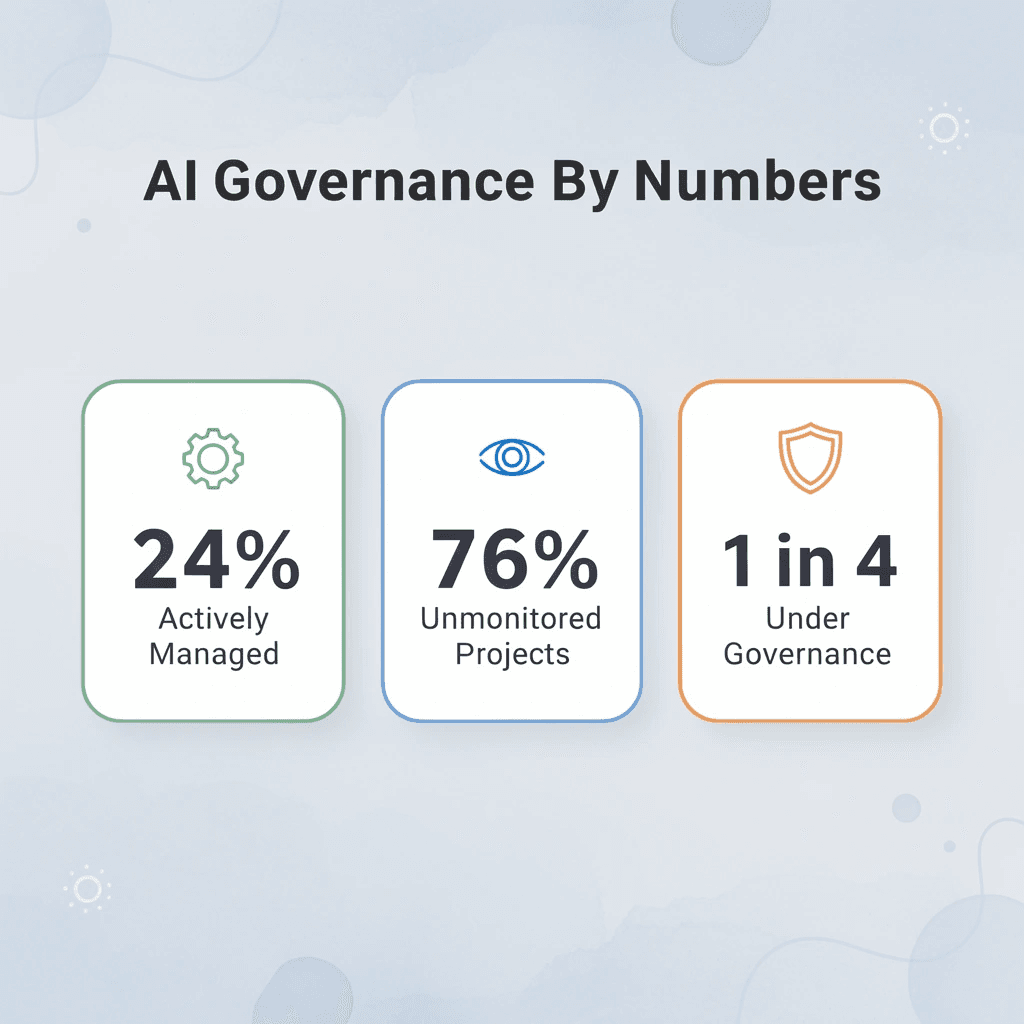
- Most enterprise AI operates without meaningful oversight. According to the IBM Institute for Business Value, only 24% of AI projects are actively governed, which means the vast majority of deployed models and workflows carry compliance, fairness, and data exposure risks that organizations have not yet structured controls for.
- Transparency and explainability are the most widely recognized governance priorities among senior leaders. PwC research found that 82% of executives identify transparency as the most critical principle in AI governance, reflecting how frequently organizations face pressure to trace AI decisions back to specific inputs, data sources, and reasoning paths when regulators or stakeholders ask hard questions.
- The financial cost of ungoverned AI is concrete and growing. Organizations without AI governance frameworks are 2.3 times more likely to experience AI-related incidents that result in financial or reputational damage, and IBM's 2025 Cost of a Data Breach report found that shadow AI added an average of $670,000 to breach costs compared with organizations that limited unauthorized AI use.
- Mature governance programs are directly linked to stronger investment returns, not weaker ones. Deloitte research identifies organizations with mature AI governance frameworks as 2.5 times more likely to report positive ROI from AI investments, a gap explained in part by avoided breach costs, regulatory fines, and the operational drag of managing incidents after the fact rather than preventing them.
- The gap between AI deployment and governance structure is wider than most organizations acknowledge. IBM Institute for Business Value data show that while 77% of enterprises are actively deploying AI solutions, only 35% have a formal governance framework in place, meaning the majority of production AI is running without the audit trails, access controls, or policy-enforcement structures needed to defend those deployments under scrutiny.
- Agentic AI creates a distinct category of governance risk that standard review processes are not built to handle. Gartner projects that by 2027, 40% of enterprises will demote or decommission autonomous AI agents after governance gaps surface only through production incidents, a pattern driven by organizations deploying agents without defined decision boundaries or real-time monitoring until something irreversible occurs.
- CodeGiant's enterprise AI platform addresses this structural gap by embedding policy enforcement, audit trails, and human-in-the-loop approvals directly into the development and deployment workflow rather than treating governance as a post-deployment review step.
What Is AI Governance and Why Is It Important for Enterprises?
Staying in control of AI systems is the difference between AI that creates growing value and AI that creates growing problems. According to the IBM Institute for Business Value, only 24% of AI projects are being actively managed — meaning most enterprise AI operates without the oversight structures needed to catch bias, data misuse, or regulatory exposure.
"Only 24% of AI projects are being actively managed, meaning most enterprise AI operates without the oversight structures needed to catch bias, data misuse, or regulatory exposure." — IBM Institute for Business Value
🚨 Warning: Operating AI systems without active management isn't a minor gap — it's a critical liability. Unmanaged AI exposes enterprises to regulatory penalties, reputational damage, and compounding errors that are far harder to reverse once embedded in production.
Managed AI |
Unmanaged AI |
|---|---|
Bias detection in place |
Bias goes undetected |
Data usage stays within policy |
Data misuse risk is high |
Regulatory exposure is minimized |
Compliance gaps accumulate |
Systems remain auditable |
Decisions become untraceable |
The gap between AI testing and production is where management matters most. Pilots are forgiving; production systems are not. When an AI model influences a loan decision, flags a patient record, or generates a compliance report, management becomes the critical control layer ensuring systems behave as intended, stay within policy boundaries, and remain fully auditable.
💡 Key Point: Every high-stakes AI output—from loan approvals to patient flags to compliance reports—depends on active governance to remain trustworthy, defensible, and aligned with enterprise policy.
🎯 Takeaway: AI governance isn't optional. It is the operational infrastructure that separates AI systems that scale safely from those that create uncontrolled risk at scale.
Why do informal oversight methods fail enterprise AI governance at scale?
Most teams handle AI oversight through manual reviews, siloed documentation, and informal checks. As AI expands across teams, data sources, and regulatory environments, these informal checks create blind spots: decisions become hard to trace, policy violations emerge after the fact, and compliance teams spend more time investigating incidents than preventing them. Our enterprise AI platform provides the audit trails, access controls, and policy enforcement needed to move from experimentation to production without sacrificing accountability.
How does enterprise AI governance reduce regulatory and financial risk?
Rules like GDPR, the EU AI Act, and specific rules in financial services and healthcare are not waiting for companies to catch up. IBM Think reports that AI governance frameworks can reduce AI-related risks by up to 30%. Governance built into the development and deployment pipeline costs less than governance added after problems emerge.
How does enterprise AI governance build stakeholder trust and accelerate adoption?
Stakeholder trust is a tangible return on governance investment. Customers, employees, and partners expect the organization to have considered how its AI behaves. This expectation is met through documented policies, clear accountability structures, and consistent enforcement—the transparency that transforms AI from a source of uncertainty into a source of confidence. Governance does not slow AI adoption. It accelerates it. Leaders lacking confidence in their AI controls keep initiatives in pilot mode indefinitely. Governance removes that hesitation by replacing vague risk with defined boundaries, enabling organizations to move from demos to production-scale systems.
What Are the Core Principles of Enterprise AI Governance?
AI governance principles are operational commitments that determine whether AI systems can be trusted, scaled, and defended under scrutiny.
"AI governance principles are the operational commitments that determine whether AI systems can be trusted, scaled, and defended under scrutiny." — Core Enterprise AI Framework
🎯 Key Point: AI governance principles are not abstract ideals — they are actionable commitments that directly impact whether your AI systems survive real-world regulatory, ethical, and operational pressure.
💡 Tip: When evaluating your organization's AI governance maturity, ask one critical question: Can every AI system you deploy be trusted, scaled, and defended? If the answer is not a confident yes, your governance principles need immediate attention.
Governance Dimension |
What It Means |
Why It Matters |
|---|---|---|
Trusted |
AI behaves reliably and ethically |
Builds stakeholder and user confidence |
Scaled |
AI can grow without breaking controls |
Ensures long-term enterprise viability |
Defended |
AI can withstand regulatory and public scrutiny |
Protects against legal and reputational risk |

Transparency and Explainability
The failure point is usually invisible until it isn't. When an AI model flags a loan application, denies a claim, or routes a support ticket, someone in your organization needs to explain why: not in vague terms, but with traceable logic tied to specific inputs, data sources, and decision paths. Transparency lets teams debug errors before they compound and defend decisions before regulators ask. According to PwC, 82% of executives identify transparency as the most critical principle in AI governance—a signal that explainability is where governance either holds together or breaks down.
Why do fairness and accountability require more than good intentions?
Fairness requires deliberate design, not good intentions. Organizations that skip structured bias audits, validation of diverse training data, and demographic parity testing discover problems in lawsuits, regulatory inquiries, or headlines. Accountability works similarly: without assigned ownership across the AI lifecycle, blame spreads when something goes wrong, preventing corrective action. Fairness testing and clear accountability structures determine whether AI systems get pulled from production or earn the right to remain.
How does Enterprise AI Governance close the accountability gap at scale?
Most teams spread responsibility among model builders, deployers, and users, with no single owner of results. As AI projects scale from one test to dozens of connected systems, this split means no one notices drift, owns the audit trail, or reports performance problems. An enterprise AI platform like CodeGiant embeds governance controls into the development and deployment workflow, enforcing accountability from the start rather than assigning it after the fact.
How do privacy and security fit into Enterprise AI Governance?
Privacy and security are fundamental to data management. Every AI system that processes customer records, employee data, or sensitive business information creates an escalating risk as it scales. Encryption, access controls, consent management, and secure processing environments are essential requirements for AI to operate without eroding organizational trust. Deloitte research shows that organizations with mature AI governance frameworks are 2.5 times more likely to report positive returns on their AI investments, partly because they avoid costs from data breaches, fines, and reputational damage.
Why does reliability complete the Enterprise AI Governance foundation?
Reliability closes the loop. An AI system that performs well in testing but drifts under real-world conditions is a liability. Rigorous validation, robustness testing, and fallback protocols enable leadership to authorize production deployment with confidence. When transparency, fairness, accountability, privacy, and reliability work together, they create a stable foundation for AI to run at enterprise scale without constant firefighting. Many organizations believe they've addressed these principles until they discover what happens when they haven't.
Related Reading
- Application Modernization Tools
- What Is Application Modernization
- How To Modernize Legacy Systems
- Build Internal Tools
- Cobol Modernization
- Mainframe To Cloud Migration
- Legacy Software Modernization
- Cobol To Java
- Technical Debt Management
- Ai Governance
- Legacy System Modernization
What Risks Do Organizations Face Without Enterprise AI Governance?
Finding out that something you thought was controlled is actually not protected often happens at the worst possible time: a regulatory audit, breach notification, or news cycle you can't control. The previous sections showed what governance looks like when it works. This one addresses what breaks when it doesn't and how fast the damage spreads.
⚠️ Warning: The moment you discover an unprotected AI system is rarely quiet—it's almost always during a crisis you're already managing.

According to PwC, organizations without AI governance are 2.3 times more likely to experience AI-related incidents that result in financial or reputational damage. That multiplier shows up in breach costs, regulatory fines, failed deployments, and lost customer trust—outcomes companies are already dealing with.
"Organizations without AI governance are 2.3 times more likely to experience AI-related incidents that result in financial or reputational damage." — PwC
🔑 Takeaway: A 2.3x risk multiplier isn't a theoretical warning—it's a measurable gap between organizations that govern their AI and those that don't, playing out in real financial losses and brand damage right now.
Risk Category |
Impact Without Governance |
|---|---|
Breach Costs |
Significantly elevated exposure |
Regulatory Fines |
Higher likelihood of non-compliance penalties |
Failed Deployments |
Increased rate of AI project failures |
Lost Customer Trust |
Reputational damage that compounds over time |
💡 Key Point: Every one of these risk categories compounds the others—a regulatory fine accelerates customer trust erosion, and a failed deployment invites even closer scrutiny from auditors.
When compliance gaps become financial exposure
The EU AI Act became fully active in August 2026, with fines of up to €35 million or 7 percent of annual global turnover for the most serious violations. Without written risk classifications, human oversight records, and conformity assessments, organizations cannot demonstrate compliance during an audit. This gap transforms routine AI use into direct legal liability, particularly as overlapping U.S. state regulations demand identical proof of control from the same systems.
Why can't a single compliance officer handle Enterprise AI Governance?
Most teams assign compliance to legal or a dedicated compliance officer, then assume the problem is solved. As AI systems spread across departments and data flows touch more regulated categories, that assumption breaks down. No single person can manually track model behavior, data lineage, and access controls across dozens of deployed systems. CodeGiant's enterprise AI platform addresses this friction point by providing a single, governed engine in which audit trails, access controls, and policy enforcement are built into the deployment rather than retrofitted after an incident.
Why does shadow AI carry such a steep financial penalty?
Security failures follow a predictable pattern in places without clear rules. Employees use unapproved tools because official options are slow or difficult to understand, and sensitive data enters outside models without tracking or oversight. According to IBM's 2025 Cost of a Data Breach report, 63% of organizations lack AI governance policies, and shadow AI added an average of $670,000 to breach costs compared with organizations that limited unauthorized use.
How does Enterprise AI Governance contain the blast radius of agentic systems?
Agentic AI amplifies this risk. When systems can initiate API calls, complete transactions, or change data with minimal human review, the blast radius of a single misconfigured agent expands rapidly. Gartner projects that by 2027, 40 percent of enterprises will demote or decommission autonomous AI agents after governance gaps surface through production incidents. Organizations deploy agents at speed without decision boundaries, real-time monitoring, or control mechanisms, only to discover their limits when irreversible damage occurs.
Related Reading
- As400 Modernization
- Enterprise Ai Governance
- Public Sector Digital Transformation
- Mendix Alternatives
- OutSystems Alternatives
- Appian Pricing
- Ai Agent Pricing
- Outsystems Vs Mendix
How to Build an Effective Enterprise AI Governance Strategy
A good enterprise AI governance strategy needs clear leadership, defined processes, consistent oversight, and supporting technology. Organizations that proactively build governance into every AI initiative can scale innovation faster while reducing operational, legal, and security risks.
"Organizations that build governance into every AI initiative can scale innovation faster while reducing operational, legal, and security risks." — Enterprise AI Governance Best Practices
🎯 Key Point: A strong AI governance strategy is built on four pillars — leadership, process, oversight, and technology — and must be embedded from day one, not bolted on afterward.
⚠️ Warning: Treating AI governance as an afterthought — rather than a core part of every AI initiative — is one of the most critical mistakes enterprises make, leading to compounding legal, operational, and security exposure.
Governance Pillar |
Why It Matters |
|---|---|
Clear Leadership |
Establishes accountability and decision-making authority |
Defined Processes |
Ensures consistent, repeatable AI deployment standards |
Consistent Oversight |
Reduces operational, legal, and security risks |
Supporting Technology |
Enables scalable governance across all AI initiatives |

✅ Best Practice: Embed AI governance frameworks directly into your innovation pipeline — organizations that do this scale faster and more safely than those who treat governance as a separate compliance exercise.
Assess Your Current AI Maturity and Risks
Conduct a thorough audit of your current AI projects, data practices, and risk exposure to establish a baseline. Document your models, track data flows across systems, identify compliance gaps, and pinpoint high-impact use cases through stakeholder interviews and audits. This diagnostic reveals priorities, prevents misaligned efforts, and addresses specific vulnerabilities.
Secure Executive Buy-In and Define Clear Roles
Work with leaders to ensure the strategy aligns with business goals and establish cross-functional governance groups with clear responsibilities. Executives support the project, provide resources, and assign roles, such as AI ethics officers or steering committee members. This embeds governance into organizational operations rather than isolating it as an IT department function.
Develop Policies, Standards, and Risk Protocols
Create detailed policies that explain what people can and cannot do with AI, set ethical rules, organize risks into different levels, and list what your company must follow based on your industry and work. Include standards for bias testing, explainability, data handling, and incident response, developed with input from legal, compliance, and technical experts. These documents give teams clear daily guidance, reducing confusion and ensuring consistent application across all projects.
Implement Tools, Training, and Operational Processes
Put technologies in place for monitoring, auditing, and lifecycle management—including model registries, automated risk assessments, and performance tracking—into existing workflows. Pair this with targeted training programs for all employee levels. Education builds awareness and skills to execute the strategy effectively, transforming governance from a compliance checkbox into an enabler of confident innovation.
Establish Monitoring, Metrics, and Continuous Improvement
Set up ongoing monitoring with key performance indicators for risk, value delivery, and compliance. Leadership tracks metrics such as model accuracy, incident rates, and business impact through dashboards and audit cycles. This iterative process keeps the strategy relevant, enabling organizations to adapt to new regulations, technologies, and lessons learned from deployments.
Best Practices for Building an Enterprise AI Governance Program
Strong AI governance means having consistent practices that guide how enterprise teams design, deploy, monitor, and improve AI systems. Organizations that follow proven governance practices reduce risk, improve compliance, strengthen customer trust, and scale AI initiatives with greater confidence.
"Organizations that follow proven governance practices reduce risk, improve compliance, strengthen customer trust, and scale AI initiatives with greater confidence."
Governance Benefit |
Business Impact |
|---|---|
Risk Reduction |
Fewer costly errors and liability exposures |
Improved Compliance |
Stronger alignment with regulations and standards |
Customer Trust |
Greater confidence in AI-driven products and services |
Scalable AI |
Faster, more reliable expansion of AI initiatives |
🎯 Key Point: AI governance is not a one-time checkbox — it's an ongoing, enterprise-wide commitment to responsible design, deployment, and monitoring of AI systems.
✅ Best Practice: Establish consistent governance practices before scaling AI initiatives to ensure compliance, trust, and risk controls are built in from the start — not bolted on after the fact.

Foster Cross-Functional Collaboration and Clear Ownership
Successful teams create dedicated governance committees with leaders from legal, compliance, IT, ethics, and business units who share responsibility for AI projects. Regular meetings and clear RACI matrices break down silos, incorporate diverse perspectives into policy development, and accelerate problem-solving while maintaining alignment with strategic goals.
Maintain a Centralized AI Inventory and Visibility
Teams build and maintain a real-time list of all AI models, datasets, use cases, and dependencies. Automated discovery tools and metadata tagging track versions, performance, and lineage. This eliminates shadow AI deployments and enables targeted risk management.
Automate Monitoring, Auditing, and Compliance Checks
Use automated tools to continuously monitor model performance, detect bias, identify security issues, and ensure regulatory compliance. Real-time dashboards surface problems as they occur while audit trails maintain records for reviews. Automation reduces manual work, ensures consistency, and frees teams to focus on high-value improvements rather than reactive firefighting.
Prioritize Training and Cultural Integration
Provide training programs for different roles that cover governance policies, ethical considerations, and responsible AI use. Ongoing education campaigns and accessible resources help teams spot risks early. This transforms governance from a top-down mandate into a shared organizational capability.
Conduct Regular Reviews and Adapt to Emerging Needs
Check your governance program regularly against important measures. Use what you learn from real-world use and changing rules. Feedback loops and maturity evaluations help you update policies, tools, and processes, keeping your practices current as technology and business needs evolve.
How CodeGiant Simplifies Enterprise AI Governance
The gap between knowing where AI risks live and actually closing them is structural, not a knowledge problem. Teams understand the exposure but lack a single place where governance is built into the work itself, not bolted on afterward through audits, spreadsheets, and retrospective reviews.
"The core failure of enterprise AI governance isn't awareness — it's the absence of structural integration that embeds oversight directly into the workflow rather than appending it after the fact."
🎯 Key Point: AI governance fails not because teams lack knowledge — it fails because oversight is structurally disconnected from the work itself, surfacing only through after-the-fact audits and spreadsheet patches.
💡 Tip: The most effective governance frameworks close the gap by making compliance and risk controls native to the development process — eliminating the need for costly retrospective reviews that catch problems too late.
Governance Approach |
When It Happens |
Effectiveness |
|---|---|---|
Audits & Spreadsheets |
After the fact |
Low — risks already realized |
Retrospective Reviews |
Post-deployment |
Medium — lessons learned late |
Built-in Governance |
During the work |
High — risks closed in real time |

Why do most enterprises lack a formal Enterprise AI Governance structure?
According to the IBM Institute for Business Value, only 35% of organizations have a formal AI governance framework, despite 77% actively using AI solutions. Most large companies run production AI without governing structures, creating operational fragility where a single undocumented agent or misconfigured integration can cascade into a breach, regulatory inquiry, or failed audit.
Why does fragmented building create an Enterprise AI Governance problem?
The same failure pattern shows up in financial services, healthcare, and manufacturing: one team puts an agent in a public cloud, another builds automations on a disconnected stack, and a third runs COBOL-era workflows nobody fully understands. Governance becomes manual archaeology rather than a living control layer. Most teams assign a compliance officer to review AI outputs after deployment, catching problems only after they're in production. As agent counts grow, the review process breaks down, and gaps widen faster than any team can close.
How does embedding Enterprise AI Governance into development replace reactive review?
Enterprise AI platforms like CodeGiant build governance into development itself rather than as a final checkpoint. Our platform includes policy checks, human-in-the-loop approvals, and secure data handling across integrations with systems like Salesforce and Snowflake throughout the prompt-to-production flow. Teams gain real-time dashboards showing deployment status, dependencies, and performance across every connected system, replacing shadow inventory with complete, auditable visibility before production.
What does Enterprise AI Governance actually enable at scale?
Good governance accelerates AI adoption, not slows it. PwC research shows that organizations with mature AI governance programs are 2.5x more likely to report strong ROI from their AI investments. When teams know what each agent does, where integrations touch sensitive data, and which workflows require human sign-off, they move faster without second-guessing deployments or waiting for legal clearance on each use case.
How does a governed platform remove friction between AI and human oversight?
A governed platform provides teams with clear rules, branching logic, and approval steps that enable AI generation and human oversight to work together seamlessly, producing reliable results rather than unpredictable ones. The harder question is whether you can afford to wait any longer to find out what it takes to get there.
Try CodeGiant's Enterprise AI Platform Today
CodeGiant closes the gap between governance and production by combining AI generation, deterministic automation, and enterprise controls into one platform. Our enterprise AI platform helps your apps, agents, and workflows move from prompt to production while maintaining compliance integrity.
"The fastest-moving teams build on a single governed engine that connects to their existing stack, enforces policy at every step, and keeps human oversight built in." — CodeGiant
🎯 Key Point: CodeGiant unifies AI generation, deterministic automation, and enterprise controls into a single platform, so your team never has to choose between speed and compliance.

The fastest-moving teams build on a single governed engine that connects to their existing stack, enforces policy at every step, and keeps human oversight built in. Visit codegiant.io to see how our App Builder, Agent Builder, and Workflow tools enable governed transformation. Production-grade control is available now.
CodeGiant Tool |
What It Does |
|---|---|
App Builder |
Build governed apps from prompt to production |
Agent Builder |
Deploy AI agents with policy enforcement built in |
Workflow Tools |
Automate workflows without sacrificing compliance |
💡 Tip: Production-grade control doesn't have to slow you down — CodeGiant's governed engine lets your team move fast while keeping compliance integrity intact at every step.
✅ Best Practice: Connect CodeGiant to your existing stack today and experience how enterprise AI can accelerate transformation without compromising oversight or control.
Related Reading
- Enterprise Architecture Modernization
- Rpg Modernization
- Iseries Modernization
- Application Modernization Benefits
- .net Modernization
- Application Modernization Roadmap
- Cobol Replacement
- Insurance Legacy Modernization