
Many businesses still run core operations on iSeries systems, also known as IBM AS/400 or IBM i, and face a real tension: the platform is stable and reliable, but aging RPG code and outdated interfaces make it harder to connect with modern applications, meet user expectations, and scale efficiently. Migrating legacy workloads, re-engineering RPG programs, or integrating iSeries with cloud environments without disrupting daily operations requires the right Application Modernization Tools and a clear strategy. The risks are real, but so is the opportunity to protect decades of embedded business logic while building toward a more flexible, maintainable system.
Modernization does not have to mean starting over or committing to a high-risk big-bang migration. Teams that take a structured approach can analyze legacy IBM i code, map dependencies, and transform RPG and COBOL programs into modern systems without losing the business logic that powers them. Whether the goal is better performance, easier integration with web and mobile interfaces, or simply reducing technical debt, the path forward becomes far less uncertain with the right support from an enterprise AI platform.
Table of Contents
- What Is iSeries Modernization and Why Does It Matter?
- What Are the Signs Your iSeries System Needs Modernization?
- Can AI Support iSeries Modernization?
- 7 Key iSeries Modernization Strategies for IT Teams
- Key Considerations for a Successful iSeries Modernization
- How CodeGiant Supports iSeries and Legacy System Modernization
- Try CodeGiant's Enterprise AI Platform Today
Summary
- IBM i and iSeries systems remain deeply embedded in enterprise operations, not as outdated relics but as load-bearing infrastructure that most organizations cannot simply shut down. Research from Nalashaa and Damco Group both indicate that 70% of Fortune 500 companies still rely on IBM i for critical business operations, which means modernization is about extending and connecting the platform, not replacing it.
- Skills availability has overtaken cybersecurity as the top planning concern among IBM i professionals for the first time since 2017. Fortra's 2026 IBM i Marketplace Survey found that 69% of respondents cited skills pressure as their primary worry, up from 60% the prior year. When institutional knowledge is concentrated in a shrinking pool of specialists, the window for an orderly, incremental modernization closes faster than most planning cycles account for.
- Security gaps in IBM i environments often go undetected until an audit surfaces them. Fortra's 2026 State of IBM i Security Study found default passwords on 10% of scanned systems, with 31% of those systems carrying more than 30 profiles in that condition, and only 31% had programs covering all 27 of the most common network exit points. The platform itself is secure, but unmodernized configurations around it frequently are not.
- AI adoption among IBM i shops is accelerating well past the experimentation stage. Fortra's survey found that shops reporting active AI use rose from 43% to 55% in a single year, with the sharpest gains in application and code development. The practical value is in structured source-level analysis, where AI can draft dependency maps and extract embedded business rules from decades-old programs far faster than manual review.
- The modernization sequence matters more than most teams initially plan for. Organizations with modern integration architectures are 2.5 times more likely to successfully scale AI initiatives, according to IBM Think Insights. This reframes the order of operations: building the integration layer and the AI capability together produces compounding returns, rather than treating modernization as a prerequisite that comes years before any AI investment.
- Integration bottlenecks are often the most visible symptom of a deeper modernization gap. DreamFactory's research shows that 48% of organizations cite complexity as their top modernization challenge, and in IBM i environments, that complexity concentrates where core system data meets every adjacent application that needs it in real time. When the integration story still relies on nightly file extracts, the business has already responded with workarounds that quietly become load-bearing.
- CodeGiant's enterprise AI platform addresses this by mapping every dependency, data relationship, and business rule in RPG, COBOL, and Db2 for i source files before generating any new code, so the logic that once lived in one person's institutional memory becomes structured, reviewable, and portable across the team.
What Is iSeries Modernization and Why Does It Matter?
The business logic running on your IBM i system took decades to earn its reliability. Payroll calculations, order pricing rules, inventory thresholds, and billing exceptions have all been tested by real transactions, failures, and fixes. iSeries modernization keeps that logic intact while removing barriers to access, change, and integration with today's systems.
💡 What It Means: iSeries modernization is not about replacing what works—it's about unlocking decades of battle-tested business logic so it can operate alongside modern interfaces, cloud platforms, and current integration standards.
Nalashaa's IBM i Modernization research reports that 70% of Fortune 500 companies still rely on IBM i systems. The platform is load-bearing infrastructure most enterprises simply cannot switch off. The real question is whether the people, interfaces, and integrations around it can keep pace with current business demands.
"70% of Fortune 500 companies still rely on IBM i systems — making it one of the most quietly dominant platforms in enterprise infrastructure today." — Nalashaa IBM i Modernization Research
⚠️ Warning: Treating IBM i modernization as optional is a risk. As interfaces age, talent pipelines shrink, and integration gaps widen, even the most reliable platform becomes a bottleneck—not an asset.
Modernization Focus Area |
The Problem Without It |
The Outcome With It |
|---|---|---|
User Interfaces |
Outdated green-screen access limits productivity |
Modern UI improves speed and usability |
System Integrations |
Siloed IBM i data can't connect to cloud tools |
Seamless data flow across platforms |
Business Logic Access |
Core rules locked inside aging RPG code |
Logic exposed via APIs for broader use |
Talent & Maintainability |
Shrinking pool of RPG/CL developers |
Modern languages attract wider talent |
🔑 Takeaway: iSeries modernization isn't about abandoning a proven platform — it's about ensuring your most reliable infrastructure doesn't become your biggest constraint.
Why the gap between IBM i and everything else keeps widening
The same problem appears in manufacturing, financial services, and government agencies: the IBM i box holds the real data, but every connected system reads a copy. A nightly file dump feeds the CRM. A manual extract updates the warehouse app. A spreadsheet checks what the customer portal shows against what the order system processed. That duplication builds quietly until a missed shipment or compliance audit exposes it.
What happens when iSeries Modernization keeps getting deferred?
Most teams add one more integration script to the existing stack, which works until the RPG specialist who wrote the original program retires and nobody can explain what the extract selects. The hidden cost is organizational knowledge walking out the door. Wrapping existing RPG and COBOL programs as callable REST services, shifting DDS-defined files to SQL tables, and replacing 5250 green-screen sessions with browser interfaces make the system easier for the next generation of developers to understand without touching the transaction engine. Platforms like CodeGiant's enterprise AI platform address this by analyzing legacy IBM i code deterministically and mapping every dependency and data relationship before generating new code, so business logic is preserved exactly rather than approximated.
What the skills pressure actually means for your timeline
Fortra's 2026 IBM i Marketplace Survey of more than 315 IBM i professionals worldwide found that skills availability became the top planning concern for the first time since 2017, cited by 69 percent of respondents, up from 60 percent the previous year. When skills pressure overtakes cybersecurity as the primary worry in a community running core financial applications, the window for orderly, incremental modernization narrows beyond most planning cycles. Waiting another budget cycle transfers risk to a smaller team with less context and higher contractor rates.
How does iSeries Modernization reduce dependency on a shrinking talent pool?
Incremental modernization addresses the most expensive surface first: APIs for systems needing live data, free-format ILE modules for frequently changing programs, SQL views for files feeding dashboards and auditors, and browser front-ends for screens new hires refuse to learn. The core transaction engine remains on IBM i, where its uptime record is unmatched. The access layer, integration surface, and development experience change, allowing work to distribute across a team using Git, VS Code, and SQL rather than concentrating in one or two people whose departure would constitute an operational emergency.
How do you know when the risk has moved from manageable to urgent?
The signs that a system has crossed from manageable to urgent are more specific than most teams anticipate.
What Are the Signs Your iSeries System Needs Modernization?
Signs that your iSeries setup needs modernization often show up as gaps between system capability and business needs—not always dramatic, but visible in daily operations.
"The most dangerous modernization gaps are the ones that feel manageable — until they suddenly aren't." — Application Modernization Best Practices
🚨 Warning: Many organizations mistake slow system degradation for normal operations — by the time the gaps become critical, the cost to fix them is significantly higher.
💡 Key Point: Modernization signals rarely arrive as a single catastrophic failure. Instead, watch for persistent friction points—sluggish performance, integration failures, and talent shortages—that quietly erode business efficiency every day.
Warning Sign |
What It Looks Like |
Business Impact |
|---|---|---|
Legacy integration gaps |
Systems can't connect with modern APIs |
Slowed workflows, data silos |
Talent scarcity |
Hard to find RPG/COBOL developers |
Rising maintenance costs |
Performance bottlenecks |
Slow processing during peak loads |
Lost productivity daily |
Compliance risk |
Outdated security protocols |
Regulatory exposure |

When one person holds the keys to everything
The warehouse app is live. The customer portal is next. But the pricing change legal approved three weeks ago sits in a ticket because the only person who will touch the order program is on PTO. That is not a staffing problem. That is a modernization problem wearing a staffing costume. According to DreamFactory's Legacy System Modernization Statistics, the average COBOL programmer is 55 years old, reflecting a broader pattern across legacy platforms including IBM i, where institutional knowledge concentrates in a shrinking group whose retirement timeline misaligns with your release calendar. When a two-line business rule change requires one specific person, freezes everything else that might call the same program, and forces an Excel workaround that finance quietly adopts as permanent, the system's access model becomes the bottleneck.
How does iSeries Modernization address single-person knowledge dependencies?
Most teams respond by writing down more information, training other team members when they have time, and hoping the key person stays. This works until it does not, and failure comes at the worst possible moment. Platforms like CodeGiant solve every dependency and data relationship clearly before generating new code, mapping the logic that lived in one person's head and making it accessible to the broader team rather than simply rehosting it elsewhere.
When integration runs on yesterday's file
Sales wants live inventory. The 3PL wants an API call. Finance wants a clean feed into the close. What they get is a scheduled extract, a mapped CSV, and a morning meeting about whose number is right. That meeting isn't a communication problem—it is evidence that your integration architecture is built around the constraints of an unmodernized access layer, not what the business needs. ITIC's 2024 Hourly Cost of Downtime Survey found that a single hour of downtime exceeds $300,000 for more than 90 percent of mid-size and large enterprises, with 41 percent reporting costs between $1 million and $5 million, excluding litigation and penalties.
On an unmodernized iSeries estate, those hours come from changes that cannot ship, batches no one will restart because the runbook lives in one person's head, or security incidents on open exit points. Standing still concentrates risk in the layer you refuse to refresh. When your integration story is still "we drop a file at 2 a.m.," the business has voted with workarounds, and those workarounds are now load-bearing.
When security looks fine until someone audits the profiles
IBM i is a secure platform. Unmodernized configurations are not. Fortra's 2026 State of IBM i Security Study found default passwords on 10 percent of scanned systems, with 31 percent of those systems carrying more than 30 profiles in that condition, and only 31 percent of systems had programs covering all 27 of the most common network exit points controlling FTP, ODBC, and related access. These gaps persist because shops treat the Power hardware as the security perimeter and neglect to update identity controls, exit-point coverage, or audit logging. An auditor does not care that the box has run for six years without incident—they care that QSECOFR still matches the username and that the FTP exit point is open.
When digital projects stall at the same sentence every quarter
E-commerce, a partner portal, a warehouse mobile app, a CRM integration: they all stop at the same line in the planning doc. "We will need a custom interface to the iSeries." That sentence repeats until product and operations stop asking, and then leadership budgets a rip-and-replace because the current system "cannot integrate."
Why does iSeries Modernization break the integration bottleneck?
The box can integrate. The outdated programs, screens, and data model cannot. When every strategic initiative waits on the same interface bottleneck, you have a clear list of what to modernize first, and the cost of inaction is measured in delayed revenue and competitors who already display inventory in real time. The answer to this pattern isn't to replace the system, but to change the entire equation.
Related Reading
- Application Modernization Tools
- What Is Application Modernization
- How To Modernize Legacy Systems
- Build Internal Tools
- Cobol Modernization
- Mainframe To Cloud Migration
- Legacy Software Modernization
- Cobol To Java
- Technical Debt Management
- Ai GovernanceLegacy System Modernization
Can AI Support iSeries Modernization?
Generative AI supports iSeries modernization in ways that go far beyond simple automation. The bottleneck in most IBM i environments is not hardware or RPG source code: it's undocumented knowledge about what the code does. AI closes that gap faster than any manual process could.
"The bottleneck in most IBM i environments is not hardware or RPG source code, but undocumented knowledge about what the code does — and AI closes that gap faster than manual processes."
💡 Tip: If your team struggles to document legacy IBM i logic, AI-assisted code analysis can surface hidden business rules buried in decades-old RPG programs without waiting months for a manual audit.
🔑 Takeaway: Generative AI doesn't just accelerate iSeries modernization — it targets the real obstacle: the knowledge gap between what your code does and what your team understands it to do.

Modernization Bottleneck |
Traditional Approach |
AI-Assisted Approach |
|---|---|---|
Undocumented business logic |
Manual code review (months) |
Automated AI analysis (days) |
RPG source code interpretation |
Senior developer dependency |
AI-generated documentation |
Knowledge transfer |
Tribal knowledge, high risk |
Structured, AI-surfaced insights |
⚠️ Warning: Relying solely on manual processes to decode legacy IBM i environments puts your organization at serious risk — especially as experienced RPG developers retire and take institutional knowledge with them.
Where AI earns its place on IBM i
The failure point is usually knowledge transfer, not compute power. A fixed-format RPG program handling freight surcharges might be 4,000 lines written across three decades by two people who no longer work there. Reading it manually, mapping every file dependency, and extracting embedded business rules takes weeks of senior developer time. Pointed at that same source member with a defined call graph, a generative model drafts a working explanation in hours. A senior RPG developer then reviews, corrects, and approves it. That split—machine for volume and expert for truth—accelerates modernization without introducing production risk.
How fast is iSeries modernization AI adoption actually growing?
The IBM i community has moved past the debate. Fortra's 2026 IBM i Marketplace Survey of 320 professionals found that AI and machine learning ranked among the top planning concerns for 42 percent of respondents, up from 18 percent two years earlier. Shops reporting active AI use rose from 43 percent to 55 percent in a single year, with the sharpest gains in application and code development. Adoption is measured and accelerating.
Why does testing AI in isolation miss the point for iSeries modernization?
Most teams test AI in isolation, separate from real modernization work. A developer tests a chat tool on a sample program, gets rough output, and concludes it is not ready for payroll. This approach never reaches the structured, source-level analysis where AI delivers real value. Platforms like CodeGiant apply AI to resolve every dependency, data relationship, and legacy nuance deterministically before generating code, producing semantically accurate, production-ready output rather than rough drafts requiring months of correction.
What does the data say about iSeries Modernization economics?
According to IBM Think Insights, organizations with modern integration architectures are 2.5 times more likely to successfully scale AI initiatives. This reshapes how IBM i shops should plan modernization: build the integration layer and AI capability together so each amplifies the other's value. An iSeries shop that shares its Db2 for i data through a governed API layer can immediately leverage natural-language querying, AI-assisted reporting, and automated workflow triggers on data it already owns.
Kyndryl's 2025 State of Mainframe Modernization Survey, fielded by Coleman Parkes Research among 500 senior leaders at enterprises running mainframe-class systems, found that 88 percent are deploying or planning generative AI on that stack. These organizations project $12.7 billion in cost savings and $19.5 billion in revenue over three years from AI work tied to environments that still hold core transactions.
Why are enterprises extending IBM i rather than replacing it?
These organizations are adding artificial intelligence to the platform that already handles their most important transactions, because replacing it carries more risk than improving it. The belief that AI belongs only after you leave IBM i does not match where serious enterprise money is going. That gap between where the money is going and where most modernization plans stop is where the most consequential decisions get made.
Related Reading
- As400 Modernization
- Enterprise Ai Governance
- Public Sector Digital Transformation
- Mendix Alternatives
- Appian Alternatives
- Ai Agent Pricing
- Outsystems Alternatives
- Appian Pricing
- OutSystems Vs Mendix
7 Key iSeries Modernization Strategies for IT Teams
Modernizing an iSeries environment preserves business logic while updating outdated components. The right strategy updates the parts that slow down your IT team while keeping capabilities that still deliver business value.
"The goal of iSeries modernization is not to replace everything — it's to preserve what works while eliminating what holds your team back." — IT Modernization Best Practices
🎯 Key Point: iSeries modernization is not an all-or-nothing overhaul — it's a targeted, strategic process that protects your core business logic while eliminating outdated bottlenecks.
💡 Tip: Before launching any modernization initiative, audit your environment to identify which components deliver active business value versus which ones simply slow your IT team down — this distinction is critical to a successful strategy.
Modernization Focus |
Goal |
Business Impact |
|---|---|---|
Outdated components |
Replace or update |
Faster IT workflows |
Core business logic |
Preserve and protect |
Continuity of value |
Legacy interfaces |
Modernize UX layer |
Improved user adoption |
Integration points |
Upgrade connectivity |
Better system interoperability |
1. Inventory Programs, Files, and Jobs Before You Touch Code
List every RPG and COBOL program, CL procedure, DDS file, SQL table, job schedule, and external interface, then mark what is unique business logic versus unused or duplicated code. IBM's modernization guidance treats this inventory as the starting point, not a side task, because a monolith hides call chains that break if you convert the wrong object first. Score each area by business impact, change frequency, and risk. Pilot the highest-impact, lowest-risk slice—such as one pricing service or inquiry screen—so the team proves a method before scaling.
2. Convert Fixed-Format RPG Into Free-Format ILE Modules
Fixed-column RPG III and older RPG IV force new developers to decipher column positions instead of business rules. IBM documents fully free-format RPG IV within the Integrated Language Environment, offering readable syntax, subprocedures, and service programs that other ILE languages can call. Convert to free-format and modularise: retain the same calculations, split oversized programs into service programs, and provide the next hire source code they can maintain in weeks rather than years. Leave high-volume batch on IBM i.
3. Rebuild the Database Layer With SQL Instead of DDS Alone
DDS-defined physical and logical files still run, but they complicate analytics, constraints, and set-based access. Define tables in SQL, add keys and referential integrity, and replace record-level CHAIN and READE patterns with embedded SQL when the workload benefits. QSYS2.GENERATE_SQL and related IBM i services help extract current definitions, so you don't have to guess at field layouts. A cleaner database lets reporting, APIs, and later services share one definition of an order or item.
4. Publish Stable Programs as REST Services With Integrated Web Services
IBM i includes Integrated Web Services (IWS), which converts ILE RPG and COBOL programs into SOAP or REST services through IBM Web Administration for i without rewriting the procedure. IWS 2.6 and 3.0 remain supported on IBM i 7.4, 7.5, and 7.6. Wrap programs that sales, warehouse, and partners need—inventory lookup, price, order status—and return JSON those teams can consume. The business rule stays in the tested ILE object; the new world communicates via HTTP instead of a 5250 session or nightly file.
5. Replace Green Screens With Front Ends That Call Those Services
A 5250 makeover that still sends function-key streams is not a strategy. Build browser or mobile screens around the workflows people actually run—create order, pick, inquire—and have those screens call the REST services you just published. IBM and practitioner guidance treat UI and API work as a pair: the interface changes, the pricing and allocation programs do not. Train warehouse and customer service on the new path while veterans keep 5250 for unfinished jobs. This split avoids a big-bang cutover while removing the onboarding wall that green screens create.
6. Move Source Into Git and a Current IDE With Repeatable Builds
SEU and PDM cannot support review, branching, or automated testing like the rest of IT. IBM supports RPG, COBOL, CL, and SQL development in Rational Developer for i and Visual Studio Code through the IBM i development extensions, documenting Git and CI/CD as the modern delivery path. Place members in a repository, compile in a pipeline, and run regression tests comparing outputs from the original program and changed module on identical input data. Delivery discipline prevents incremental modernization from becoming an untestable collection of one-off edits.
7. Replatform only the modules that must leave, after you map them
Most of the estate should stay on IBM i or move as IBM i onto IBM Power Virtual Server when the goal is to leave the machine room, not the language. Some isolated COBOL or RPG batches need a cloud-native service that other platforms already host; that is where a mapped conversion belongs.
Which modules are right candidates for iSeries Modernization through conversion?
CodeGiant describes an integrated enterprise modernization platform that transforms legacy code into production-ready cloud-native software by resolving dependencies, data relationships, and types before generating code and deploying to AWS, Azure, and Google Cloud. Use this approach for bounded modules with clear contracts, not undocumented systems like your order engine. Maintain functional equivalence tests against live inputs to ensure the converted service matches the original behavior before switching traffic.
Key Considerations for a Successful iSeries Modernization
A successful iSeries modernization is a controlled sequence of decisions about which programs stay, which interfaces change, who owns the knowledge, and how you prove the new path matches the old one before the business depends on it.
"Modernization is not a single event — it is a controlled sequence of decisions that determines whether your legacy investment becomes a liability or a launchpad." — Software Modernization Best Practices
🎯 Key Point: The most critical factor in iSeries modernization is not the technology you choose — it's the decision framework you build around program retention, interface changes, and knowledge ownership.
⚠️ Warning: Skipping the validation step — proving the new path matches the old one — is the single most common reason modernization projects fail before the business can depend on the result.
Decision Area |
Key Question to Answer |
|---|---|
Program Retention |
Which legacy programs stay as-is? |
Interface Changes |
Which touchpoints must be redesigned? |
Knowledge Ownership |
Who holds critical institutional knowledge? |
Path Validation |
How do you prove the new system matches the old? |
Tie Every Wave to a Business Outcome, Not a Technology Label
IBM's modernization material advises teams to start with user and stakeholder pain—slow order changes, green-screen training, missing live feeds—rather than platform slogans. Name outcomes in operational language: same-day price updates, warehouse scans that post to inventory without rekey, CRM that reads live order status. Score candidates by outcome impact, code change frequency, and blast radius if it fails. Work that doesn't move a metric waits. This filter prevents two-year "modernize everything" programs that never ship usable services.
Map Dependencies Before You Promise Dates
Homegrown IBM i applications call other programs, share DDS or SQL files, and sit on job schedules that finance and operations treat as law. A list of RPG and COBOL objects, CL, files, data queues, and external interfaces serves as the planning document. IBM Redbooks on modernizing IBM i applications emphasize understanding the architecture before undertaking modular work. Without that map, an API wrap on one inquiry program breaks a night job nobody listed. With it, you isolate a pilot, freeze related objects, and give leadership a defensible date.
Choose a Path Per Workload Instead of One Doctrine for the Whole Box
You can refactor code in place, wrap it as a service, move IBM i to Power Virtual Server, or rewrite a bounded module. IBM documents free-format ILE RPG, SQL-centred database design, and Integrated Web Services that publish existing ILE programs as REST or SOAP without a rewrite. IBM also supports running IBM i on Power Virtual Server when the goal is to leave the machine room, not the language. Rewrite code only if it is isolated, poorly structured, and cheaper to replace than to maintain. Applying one doctrine across payroll, warehouse, and reporting stalls projects.
Treat Skills and Documentation as Project Scope
The work fails when only one person understands the allocation program. Build knowledge transfer into the backlog: extract rules from source, record why edge cases exist, and pair a senior RPG developer with someone who already uses Git and SQL. Measure success as "two people can change and test this module," not as "we installed a new IDE."
Fold Security and Audit Into the Same Release, Not a Later Phase
New APIs, file transfers, and web fronts expand attack surfaces even when the Power box itself stays secure. Fortra's State of IBM i Security studies consistently find default passwords and incomplete exit-point coverage on live partitions. A modernization wave that shares inventory over HTTP without current authentication, object-level authority, logging, and exit strategies for FTP and ODBC trades one risk for another. Include identity, encryption, and audit in the definition of done for each service so compliance reviews see a tighter system, not a new hole alongside an old one.
Prove Equivalence With Parallel Runs and Automated Comparison
Order, invoice, and inventory programs cannot accept "close enough." Keep the original ILE program running while the new interface or module processes the same inputs at the same time. Compare outputs on price, quantity, tax, and status until you explain and fix any differences. IBM guidance on application modernization emphasizes test-driven work and automation: the discipline required to stop using the 5250 path. Skip it and month-end close becomes your test environment.
Keep Releases, Hardware, and Governance on a Written Cadence
IBM i 7.4 left standard support on September 30, 2026, and moves to paid Service Extension through September 30, 2029. Shops that ignore release and Power refresh calendars convert planned modernization into emergency upgrades. Assign an owner, establish a steering cadence, and require rollback and production owner approval before each wave. IBM's upgrade readiness checklists prevent skipped requirements such as agreements, LIC space, and supported models that halt installs. Governance ensures incremental work stays aligned with your infrastructure.
How CodeGiant Supports iSeries and Legacy System Modernization
Most modernization approaches treat the IBM i system as something to escape rather than understand, resulting in plans built on assumptions rather than evidence. This is where rewrites fail before development even begins.
"Plans built on assumptions rather than evidence are where IBM i modernization projects collapse — before a single line of new code is written."
🚨 Warning: Treating your IBM i / iSeries system as something to simply escape — rather than deeply understand — is the #1 reason modernization projects fail at the planning stage.
💡 Key Insight: CodeGiant takes a fundamentally different approach — grounding every modernization roadmap in evidence-based analysis of your existing system, not guesswork.
Common Modernization Mistake |
CodeGiant's Approach |
|---|---|
Treat IBM i as something to escape |
Understand the system deeply before acting |
Build plans on assumptions |
Ground decisions in evidence and analysis |
Begin rewrites prematurely |
Validate the roadmap before development starts |

What changes when you map before you move
CodeGiant's approach starts with something most modernization vendors skip: a complete, clear map of what the system does. Kronos LLMs extract business logic, build control flow graphs, identify dependency chains, and surface decision rules hidden in RPG and COBOL source files. This matters because the pricing rule nobody documented in 2009 still runs every order confirmation today. Without that map, conversion becomes guessing.
Why does iSeries Modernization start with eliminating single points of failure?
The same pattern shows up across manufacturing, financial services, and government: a team inherits a working system with no documentation, no test suite, and one remaining developer who understands how everything works. CodeGiant replaces that single point of failure with structured dependency maps and relationship graphs the whole team can read and use. Knowledge moves from one person's head into a system the organization controls.
How does iSeries Modernization validate logic before traffic ever moves?
CodeGiant solves the manual tracing problem directly. Our platform transforms RPG, COBOL, CL, DDS, and Db2 for i into modular, callable services with functional and behavioral equivalence checks built into the pipeline. The new service is validated against the original logic before any traffic moves, preventing month-end failures rather than discovering them after the fact.
Where converted services actually land
Conversion without deployment is a proof of concept. According to CodeGiant's Technology Modernization documentation, our platform supports eight cloud deployment targets: AWS, GCP, Azure, Cloudflare, Oracle Cloud, DigitalOcean, Fly.io, and Alibaba. The DevOps toolchain, CI/CD pipeline, Terraform configuration, and observability layer come with the conversion, so teams avoid rebuilding deployment scaffolding from scratch.
Which target languages does iSeries Modernization output support?
Companies running IBM i alongside SAP, Salesforce, or cloud-native systems need the modernized service to speak the same infrastructure language. According to CodeGiant's Technology Modernization documentation, our platform supports transformation into four programming languages: COBOL/NetCOBOL, Java Spring, JavaScript/Next.js, and Node.js. The converted service becomes a first-class citizen of the modern stack, not a legacy adapter bolted on the side.
How do ongoing operations fit into the iSeries Modernization picture?
Every service shipped through CodeGiant includes an AI SRE that monitors logs, metrics, and traces in production, fixes incidents, tunes latency and cost, and automatically keeps runbooks current. Most modernization plans overlook this operational reality once migration closes.
Related Reading
- Enterprise Architecture Modernization
- Rpg Modernization
- Application Modernization Benefits
- .net Modernization
- Application Modernization Roadmap
- Cobol Replacement
- Insurance Legacy Modernization
Try CodeGiant's Enterprise AI Platform Today
If your iSeries environment is slowing down application changes, trapping business logic, or forcing your team to manage modernization through disconnected tools, effective modernization requires dependency mapping, logic preservation, modern architecture, reliable deployment, and strong production operations: capabilities that rarely align when connecting separate tools across vendors.
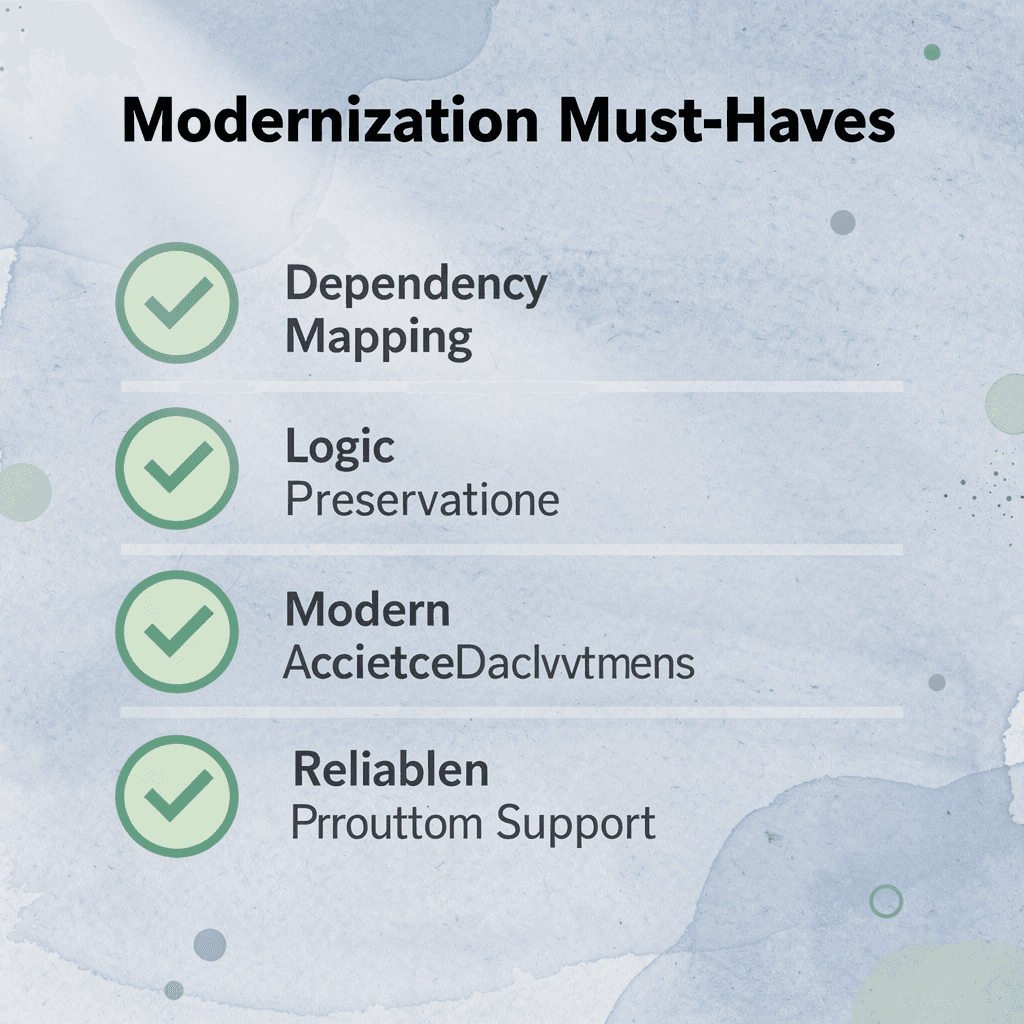
CodeGiant brings that entire path into one platform: source-level analysis of RPG, COBOL, and Db2 through cloud-native transformation, integrated DevOps, enterprise connectivity across more than 3,000 services, and AI-assisted production operations that continue working after go-live. Our enterprise AI platform helps you move from planning to execution.