
Many IBM i shops run decades-old RPG code that still powers core business operations but grows harder to maintain, extend, and staff each year. Fixed-format RPG programs were built for a different era, and aligning them with modern development standards requires more than cosmetic changes. Converting to free-format RPG IV, improving code readability, and reducing accumulated technical debt are all practical steps teams can take without dismantling what already works.
The right application modernization tools make this process faster and lower risk, especially for teams that cannot afford lengthy rewrites or extended manual effort. CodeGiant is built specifically for this kind of work, helping development teams modernize RPG code safely and improve long-term maintainability across IBM i systems. For teams ready to take a structured approach, the enterprise AI platform gives them a clear path forward.
Table of Contents
- What Is RPG Modernization and How Does It Work?
- Why Is RPG Modernization Important for IT Teams?
- What Challenges Do IT Teams Face During RPG Modernization?
- 7 Key RPG Modernization Strategies for IT Teams
- Key Considerations for a Successful RPG Modernization
- How CodeGiant Supports RPG Modernization
- Try CodeGiant's Enterprise AI Platform Today
Summary
- RPG modernization rarely fails because of the code itself. The real failure point is assuming someone already understands the full picture: what a system does, which programs call which, where business rules live, and what implicit cycles quietly run in the background. Fixed-format RPG written in the 1980s and 1990s almost never comes with documentation that maps any of that, so the institutional knowledge lives in the heads of two or three people, and when those people leave, the map leaves with them.
- The mechanical work of conversion is more tractable than most teams expect. According to ARCAD Software, 95 percent of RPG code can be automatically converted to free-format syntax. The harder work is validating that the logic came through intact, particularly for decision rules that were never written down and exist only in the memory of a senior developer who may already be close to retirement.
- The RPG skills pipeline isn't recovering, and the cost of waiting compounds every month. Open roles go unfilled while the same specialists cover production schedules, month-end closes, and emergency patches. Each new integration requirement gets built as a one-off patch rather than a reusable service, and every time someone new touches the codebase, it becomes slightly less understood.
- Complexity, not syntax, is the primary barrier to modernization. According to DreamFactory's legacy system modernization research, 48 percent of organizations name complexity as their top modernization challenge. That complexity is almost never about the language itself. It lives in the organizational conditions surrounding the code, specifically who knows what, who is available, and what happens when those two answers point to the same person.
- Most project timelines underestimate the structural tension between keeping production running and executing a modernization effort. The same small team responsible for daily batch jobs, help desk escalations, and quarter-end closes is also the team expected to run modernization sprints. When a production issue arrives mid-sprint, it wins every time; context is lost, and the modernization timeline slips further. Teams that solve this treat modernization as a continuous operational process, not a bounded project.
- According to the Red Hat State of Application Modernization Report, 71 percent of organizations say application modernization is extremely or very important to their business strategy, yet fewer than 60 percent have a formal strategy in place. The same report finds that 54 percent of organizations cite legacy application modernization as a top IT priority over the next 12 months, meaning the pressure to act is real, but so is the risk of acting without a verified, controlled process.
- CodeGiant's enterprise AI platform addresses this directly by using Kronos LLMs to map every dependency, data relationship, and legacy nuance deterministically from the source before generating a single line of modernized code, so the analysis does not depend on institutional memory that may already be walking out the door.
What Is RPG Modernization and How Does It Work?
RPG modernization updates business logic in Report Program Generator, so it connects to current systems, supports a wider talent pool, and survives the retirement of its original developers. The work starts by understanding what the existing code does, dependency by dependency, before modifying anything.
"RPG modernization begins not with rewriting — but with reading: mapping every dependency, every business rule, and every hidden assumption baked into decades-old code before a single line changes." — Legacy Systems Best Practice
💡 What This Means in Practice: RPG modernization is not a simple upgrade. It's a structured process of auditing business logic, mapping system dependencies, and rebuilding connections to modern infrastructure without losing the original code's purpose.
🔑 Key Takeaway: The most critical step in RPG modernization is the discovery phase: understanding the existing codebase completely before any transformation work begins. Organizations that skip this step risk breaking mission-critical business logic that has run silently for decades.

Why does understanding the full picture matter before RPG modernization begins?
The failure point in most modernization projects isn't the conversion itself, but the assumption that someone understands the full picture: which programs call which, where business rules live, and what implicit cycles run behind the scenes. Fixed-format RPG written in the 1980s and 1990s rarely comes with documentation mapping any of that. Institutional knowledge lives in two or three people, and when they leave, the map leaves with them.
What are the four phases of an RPG modernization project?
The typical modernization path moves through four connected phases. First, teams inventory every program, file, call stack, and data flow to surface what the system does versus what stakeholders believe it does. Second, fixed-format RPG IV source converts to free-format RPGLE, replacing unnamed indicators and implicit program cycles with explicit procedures that modern developers can follow. Third, proven business logic gets wrapped as REST or SOAP services so modern applications can call the same calculations without modifying the original RPG programs. Fourth, 5250 green-screen interfaces give way to web or mobile front ends that consume those services.
Most teams handle this manually, relying on experienced developers to trace dependencies and flag risks before each conversion step. When those veterans retire, the approach breaks down. Our enterprise AI platform addresses this by using Kronos LLMs to map every dependency, data relationship, type, and legacy nuance before generating modernized code, eliminating reliance on institutional memory that may be leaving.
How does modernizing the database layer reduce future RPG modernization work?
The database layer follows the same logic. Most older RPG applications define files using Data Description Specifications, a format that locks business rules inside program code and hides the data layer from modern query tools. Converting those file definitions to SQL DDL moves constraints and indexes into the database where they belong, enabling other systems to query the data layer directly. This single change often reduces future modernization work because fewer rules remain buried in application logic.
Why does the sequencing of RPG modernization work matter so much?
RPG modernization directly addresses a shrinking pool of programmers who know the language, making the order of this work critical. Get it wrong, and you're converting code nobody fully understands, so the new version inherits the same hidden risks as the old one. But knowing how modernization works is only half the story. The harder question concerns what happens to the teams responsible for maintaining these systems during the transition.
Why Is RPG Modernization Important for IT Teams?
RPG teams manage overwhelming competing demands — production schedules, break-fix requests, training contractors on forty-year-old syntax, and evaluating modernization proposals — often with minimal resources. RPG has powered enterprise systems for over four decades, embedding institutional knowledge that is frequently irreplaceable. When that knowledge lives exclusively in a few senior developers, even routine maintenance becomes a hidden organizational risk.
"When institutional knowledge lives exclusively in a few senior developers, routine maintenance becomes a hidden risk." — Core RPG Modernization Challenge
💡 Tip: If your RPG knowledge is concentrated in one or two individuals, your organization is one retirement away from a critical skills gap — start knowledge transfer planning now.
⚠️ Warning: Break-fix requests and legacy training burdens are not just productivity drains — they are early warning signs of a system that has outgrown its current support model.
RPG Team Challenge |
Why It Matters |
|---|---|
Managing production schedules |
Delays ripple across entire enterprise operations |
Handling break-fix requests |
Consumes bandwidth meant for strategic modernization |
Training contractors on legacy syntax |
Forty-year-old code requires specialized, hard-to-find expertise |
Evaluating modernization proposals |
Requires deep institutional knowledge that is rarely documented |

What actually breaks when modernization stalls
The failure point is usually invisible until it is not. A tax rule changes, a new warehouse system needs a data feed, or a compliance audit asks for a calculation trail. Each request hits the same wall: logic buried in monolithic RPG programs with no external interface, documentation, or clear owner. Workarounds accumulate, the codebase becomes harder to read with each sprint, and the system becomes one that only a handful of people dare to touch—and those people are already stretched.
What does RPG Modernization cost when institutional knowledge walks out the door?
Most teams assign their most experienced RPG developer as the permanent go-to person for anything complex. When that breaks, the cost extends beyond delayed tickets: business units lose trust in IT, portal projects ship months late, or compliance gaps surface during audits. Platforms like CodeGiant approach this differently. Rather than relying on human memory to trace dependencies, our Kronos LLMs map every data relationship, type, and legacy nuance deterministically before conversion begins. Institutional knowledge locked inside aging RPG source gets surfaced and preserved, not lost in translation.
Why the skills gap makes timing critical
The RPG skills pipeline is not recovering. Open roles sit unfilled while the same specialists cover nights, month-end closes, and emergency patches. Each month without action compounds two costs simultaneously: specialist time grows more expensive and harder to replace, and every new integration requirement gets built as a one-off patch rather than a reusable service.
How does each delay make RPG modernization harder to execute?
Each new connection to an e-commerce layer or mobile approval workflow takes longer than the last, not because the problem is harder, but because each new developer makes the underlying code harder to understand.
What happens when organizations wait too long to act?
Incremental modernization—converting source to readable free-format RPGLE, wrapping stable business logic as services, and connecting those services to modern tooling—is the practical alternative to expensive forced replacement after a crisis. Organizations that wait until the last RPG expert retires face a binary choice: freeze the system or rebuild under pressure without the people who understood the original rules. Neither is acceptable when the programs run pricing, allocation, or compliance calculations the business depends on daily.
The gap between strategy and execution
Most IT leaders recognise that modernization is important, but they face operational constraints, competing priorities, and fear of disrupting running systems. RPG modernization offers a path that doesn't require choosing between stability and progress: existing business logic stays intact, cloud-native microservices build on top of the current stack, and the green-screen interface gets replaced without touching calculations underneath. This keeps trusted logic alive while making it accessible to modern applications. Knowing why modernization matters and executing it without breaking production are two different challenges, and the second is where most teams encounter unexpected friction.
Related Reading
- Application Modernization Tools
- What Is Application Modernization
- How To Modernize Legacy Systems
- Build Internal Tools
- Cobol Modernization
- Mainframe To Cloud Migration
- Legacy Software Modernization
- Cobol To Java
- Technical Debt Management
- Ai GovernanceLegacy System Modernization
What Challenges Do IT Teams Face During RPG Modernization?
Execution is where planning meets reality, and the gap between them is wider than most project timelines account for.
"The distance between a modernization roadmap and a modernization outcome is measured in organizational friction, not lines of code."
⚠️ Warning: Teams that underestimate the execution gap routinely exceed deadlines and budgets before rewriting a single line of RPG.
The friction stopping RPG modernization teams is not technical syntax or compilers. According to DreamFactory's Legacy System Modernization Statistics, 48% of organizations name complexity as their top modernization challenge—complexity rooted in organizational conditions: who knows what, who is available, and what happens when those two answers point to the same person.
🔑 Takeaway: When 48% of organizations cite complexity as their #1 barrier, the real bottleneck is people and process—not the RPG language itself.
Challenge Type |
Root Cause |
Impact |
|---|---|---|
Organizational Complexity |
Knowledge silos, limited availability |
#1 barrier for 48% of orgs |
Technical Debt |
Decades of undocumented legacy code |
Slows every migration phase |
Skills Gap |
Shrinking pool of RPG expertise |
Creates single points of failure |
💡 Tip: Before writing a single migration plan, map your knowledge dependencies—identify exactly which team members hold critical institutional knowledge and build redundancy before modernization begins.
When the spec lives inside one person's memory
The failure point is usually retirement, resignation, or reorganization. RPG shops that have run the same billing or inventory logic for fifteen or twenty years often have one or two people who carry the system's real behavior in their heads—not in documentation, comments, or test suites. When those people leave, the team loses the ability to verify whether a change is correct. That verification gap turns a straightforward field-type migration into a six-month investigation, because every edge case must be reconstructed from production data and user memory rather than a written specification.
Why does RPG modernization stall when key developers leave?
DreamFactory's research shows that the average COBOL programmer is 55 years old, and RPG shops face the same challenge. The people who understand the deepest system layers approach retirement. Teams that defer this concern discover it becomes urgent during projects, when the developer who understood the month-end allocation routine has departed.
How can RPG modernization move forward without relying on tribal memory?
Most teams rely on informal knowledge transfer—pairing a senior developer with a junior one and hoping context travels. Instead, the senior developer answers production questions while the junior watches, and structured discovery work never gets scheduled. Platforms like CodeGiant take a different approach: our Kronos LLMs map every dependency, data relationship, and legacy nuance clearly before any code changes, capturing the system's actual behavior as structured knowledge rather than tribal memory. This shifts discovery from human memory to machine analysis, so work doesn't stall when the expert is unavailable.
Why keeping production running and modernizing at the same time is genuinely hard
The same small team that runs modernization sprints handles daily batch jobs, help desk escalations, and quarter-end closes. Modernization requires focused, uninterrupted analysis, while production demands immediate, reactive response. These two modes conflict in a three-person development group. When a production issue arrives mid-sprint, it wins. The modernization work pauses, context is lost, and the next sprint starts with the team relearning where it stopped.
Why is this a structural problem rather than a discipline problem?
This is not a discipline problem: it is a structural one. Teams that solve it treat modernization as a continuous operational process, not a bounded project. When the transformed application ships through a DevOps toolchain with autonomous monitoring and repair, the production burden shrinks. Keeping things running stops competing with making things better, and the modernization timeline gains room to move.
What makes RPG modernization tension so difficult to resolve?
The hardest part is accepting that the system you are trying to change is also the system you cannot afford to break, and that tension does not resolve itself.
Related Reading
- As400 Modernization
- Enterprise Ai Governance
- Public Sector Digital Transformation
- Mendix Alternatives
- Appian Alternatives
- Ai Agent Pricing
- Outsystems Alternatives
- Appian Pricing
- OutSystems Vs Mendix
7 Key RPG Modernization Strategies for IT Teams
Modernizing an RPG application means keeping the valuable business logic that already works while improving the code, data, interfaces, integrations, and development practices. Each strategy below protects the logic your business already trusts and removes one specific blocker: unreadable source code, missing interfaces, green screens, or a database that new systems cannot query.
"The goal of RPG modernization is not to replace what works — it's to remove every barrier that prevents trusted business logic from powering modern systems." — IT Modernization Best Practices
🎯 Key Point: RPG modernization is not about rewriting everything from scratch — it's about surgically removing blockers while preserving the core business logic your organization depends on.
💡 Tip: Before selecting a modernization strategy, map each blocker — whether it's a green screen UI, an unreadable codebase, or an isolated database — to the specific strategy designed to eliminate it.
Blocker |
Modernization Strategy Target |
|---|---|
Unreadable source code |
Code structure & refactoring |
Green screen interfaces |
UI/UX modernization |
Missing integrations |
API & integration layer |
Isolated database |
Data accessibility & querying |
Outdated dev practices |
DevOps & toolchain modernization |
1. Inventory the Estate and Rank Work by Business Risk
Start with a map, not a compiler. List every RPG program, copybook, display file, data file, and scheduled job. Trace call stacks and note which programs price orders, allocate stock, or close the books. Rank them by change frequency, knowledge distribution, and impact if they fail. Prioritize a pricing service used by three channels; a once-yearly report can wait. Without this inventory, you risk converting the wrong programs, missing dependencies, and discovering production gaps. The code itself is the only complete record of the rules.
2. Convert Fixed-Format RPG to Free-Format RPGLE
Fixed-format RPG obscures its logic behind indicators and the cycle. Free-format RPGLE uses structured statements that any developer familiar with modern languages can follow. The conversion preserves calculations and files while improving readability through named procedures that replace unnamed indicators, clear loops that replace hidden cycle logic, and comments placed next to the rules they describe. New staff no longer see the source code as a foreign language. Maintenance time drops because changes are easy to track end to end. IBM designates free-format as the standard way to write modern RPG on IBM i, and tools such as Code for IBM i in Visual Studio Code support the edit-compile-test loop in that syntax.
3. Break Monoliths Into ILE Procedures and Service Programs
A 4,000-line program that paints a screen, reads a file, and applies five pricing rules is hard to test and risky to change. ILE lets you extract each rule into a procedure and bind related procedures into a service program with a published interface. Callers—other RPG programs, COBOL, CL, or a web service—use that interface instead of copying the logic. One pricing change then lives in one place, debugging shrinks to a single module, and future API work becomes a wrapper around an already-isolated procedure. This is the IBM i equivalent of building a library: the business logic stays on Power and Db2 but is no longer trapped inside a screen program. The IBM Redbook on modernizing IBM i applications treats ILE modularity as a core development practice.
4. Wrap Proven Logic as REST and Web Services
Sales, the warehouse, and the customer portal all need the same answers that your green-screen programs already produce. Instead of rewriting those programs, you can expose them. IBM i Integrated Web Services and similar REST wrappers can turn an RPG procedure into an HTTP endpoint. The portal posts an item and customer; the service returns availability and price from the same code that has run for years. Authentication, versioning, and payload format sit at the edge while the RPG program remains the system of record. This strategy unblocks digital projects without a cutover weekend and without betting the company on a specification that never captured the exceptions. IBM lists API connection as a standard RPG modernization path alongside interface refresh and code cleanup.
5. Replace 5250 Screens Without Touching the Engine
Users dislike green-on-black terminals but accept the math that runs them. UI modernization puts a web browser or mobile front end in front of the same programs or new services. Staff complete transactions with less training, and mistakes from misreading function keys disappear. The business sees progress in weeks, which funds deeper refactoring still pending. Keep the 5250 path available during the overlap so operations never depend on a single untested screen. IBM describes this interface refresh as the fastest visible improvement inside IBM i modernization because the underlying logic remains unchanged.
6. Move Data Access From DDS Files to SQL
Older RPG programs define files with Data Description Specifications and read them with native I/O, locking business rules inside programs and hiding the data model from other systems. Convert those files to SQL tables and views (DDL) on Db2 for i, placing constraints, keys, and shared rules in the database. Switch programs to embedded SQL so developers trained on any current stack can read the access path. Reporting tools, APIs, and analytics then query the same tables without custom extracts. Start with files behind the highest-volume transactions, prove results match, then repeat. IBM's guidance on modernizing IBM i applications treats this data-centric shift as a core practice.
7. Transform Selected Programs Into Cloud-Native Services When Wrapping Is Not Enough
Some applications need more than a new screen and an API: the skill pool has disappeared, the program must run alongside cloud services, or leadership requires code that a larger engineering team can maintain. Convert isolated, well-mapped programs into modern services and keep IBM i as the system of record for what still fits. IBM lists translation into newer languages and a move to the cloud among standard RPG modernization paths.
How does CodeGiant support full RPG modernization to cloud-native software?
CodeGiant is an integrated enterprise AI platform for modernizing legacy code into semantically accurate, production-ready, cloud-native software. Our specialized harnesses map dependencies, data relationships, and types before generation starts, so conversion begins from a resolved model rather than a guess. Converted services deploy as containerized, cloud-native applications through our toolchain, enabling teams to build new apps and workflows on their existing stack. Use this path only after inventory, free-format conversion, and APIs have shown which programs truly need a new runtime.
Key Considerations for a Successful RPG Modernization
A successful RPG modernization is a planning problem first. Shops that finish decide what "done" means, which programs deserve which treatment, and how they'll prove the new version matches the old one before production cutover.
"A successful RPG modernization is a planning problem first — shops that finish are the ones that define what 'done' means before writing a single line of new code."
🎯 Key Point: Before touching a single line of legacy code, your team must define "done" — without it, modernization projects drift, stall, and fail.
💡 Tip: Map every RPG program to a specific modernization treatment (rewrite, refactor, or retire) early in the planning phase to avoid costly mid-project pivots.
Decision |
Why It's Critical |
|---|---|
Define "done" |
Prevents scope creep and misaligned expectations |
Assign program treatment |
Ensures the right approach for each legacy asset |
Prove version parity |
Validates the new system before production cutover |

Decide What Problem You Are Solving Before You Pick a Technique
Talent shortages, green-screen rejection, missing APIs, and rising maintenance costs may look like a single problem, but they aren't. A shop needing a customer portal doesn't require language conversion on day one. A shop that lost its last RPG specialist needs readable source code and multiple people who understand the rules. Write the outcome in business language—orders priced consistently, inventory visible to the warehouse app, new hires able to change a tax table—then choose wrap, refactor, or convert against that list. IBM's framing of RPG modernization lists several distinct moves (interface refresh, APIs, code cleanup, language translation, cloud) because each addresses a different pressure. Mixing them without a target wastes the few people who still know the system.
Treat the Source as the Specification You Never Wrote
RPG applications running for decades have pricing quirks, allocation exceptions, and month-end paths never documented in design specs. An inventory listing programs, copybooks, files, jobs, and call stacks shows which modules are business-critical, which haven't been touched in years, and which share files you cannot rename without breaking three channels. Skip this, and you convert a report while the order program stays in fixed-format columns. IBM's application-modernization guidance starts with portfolio assessment for this reason: disposition (refactor, wrap, leave, replace) only works after you know what you have.
Capture Knowledge While the Authors Are Still in the Building
The remaining RPG specialists are the project's scarcest resource and its only living documentation. Schedule time with them to walk through exceptions, not to write new features. Record why a customer class gets a Tuesday discount, which indicator means "already allocated," and which batch job must finish before invoicing starts. Pair a newer developer on that walk-through so the knowledge is no longer a single point of failure. When that specialist retires mid-project, reconstruction from production data replaces planning. Fortra's 2026 IBM i Marketplace Survey already placed IBM i skills as the community's top concern; a modernization plan that ignores knowledge transfer assumes a staffing market that does not exist.
Match the Approach to the Application, Not the Slogan
One estate needs more than one method. A stable pricing routine with a clear interface is a candidate for a REST wrapper. A 4,000-line screen program is a candidate for free-format conversion and ILE procedures. A dead report is a candidate for retirement. A program that must run alongside cloud services and that no one on staff will maintain is a candidate for targeted translation. Applying a single slogan ("rewrite everything" or "never leave RPG") to every object creates either a multi-year rewrite or a shop that still cannot hire. IBM describes RPG modernization as cosmetic or deep: interface and API work leave the engine in place; refactoring and SQL change the structure without changing the result. Choose per program after the inventory, not during the kickoff.
Prove Equivalence Before You Cut Over
Classic RPO shops rarely own an automated regression suite. Testing meant a senior user walking a 5250 path through month-end. Modernization without a baseline is a guess. Extract known results from production—prices, allocations, tax lines, invoice totals—and lock them as expected outputs before changing syntax, files, or screens. After each slice, run the same cases against the new procedure, service, or interface. IBM's 2026 Redbook on modernizing IBM i applications treats test-driven development and automation as core modernization practice, not a phase added at the end. A conversion that compiles but fails on twice-a-year exceptions is untested, not modernized.
Modernize How the Team Builds, Not Only What the Compiler Sees
Free-format RPG in a library edited only with SEU is a bottleneck. Move source into version control, adopt Code for IBM i or Rational Developer for i, and promote through a repeatable path instead of homemade copies. Automated compiles and a short test pack on every change prevent the "it worked on my session" failures that occur after the expert leaves. The Fortra 2026 survey showed Visual Studio Code usage overtaking RDi while the Application Development Tool Set remained widely used; this split creates delivery risk until the team agrees on one promotion path. IBM's Redbook pairs modern RPG syntax with modern tools, CI/CD, and automated testing because readable code without a safe deployment process still freezes production.
Keep Production Capacity and Business Users Inside the Plan
The people who need to update the order program are the same people who fix it when problems occur at month-end. A plan consuming 100 percent of their time leaves no capacity for regular work. Reserve capacity and organize work in small increments so that reverting to the old system requires a program swap, not a weekend effort. Involve users who know the correct result for each piece; they can identify exceptions the instructions never mentioned. Gartner's research on digital projects found that success rates increase when technology and business leaders collaborate; RPG modernization follows that pattern because the correct answer comes from operations, not IT alone.
Protect the System of Record When You Open It
APIs and new interfaces expose logic that was previously hidden behind a terminal and user profile: a major security shift. You must decide who can call each service, what data leaves IBM i, and how you record the call. Don't deploy a pricing program on the network using rules designed for 5250 sessions within your building. Keep Db2 as the system of record until a converted service proves it writes identical results. Gradual exposure—one service, one user, one audit trail—works better than opening a wide gateway that no one owns after the project team leaves.
How CodeGiant Supports RPG Modernization
Modernization efforts succeed not through bigger budgets or longer timelines, but by treating modernization as a structured, repeatable process with clear inputs and verifiable outputs, not as a single event.
"Modernization succeeds when it is treated as a structured, repeatable process with clear inputs and verifiable outputs—not as a single event."
🎯 Key Point: Failed and successful modernization projects differ not in budget but in process discipline and repeatability.
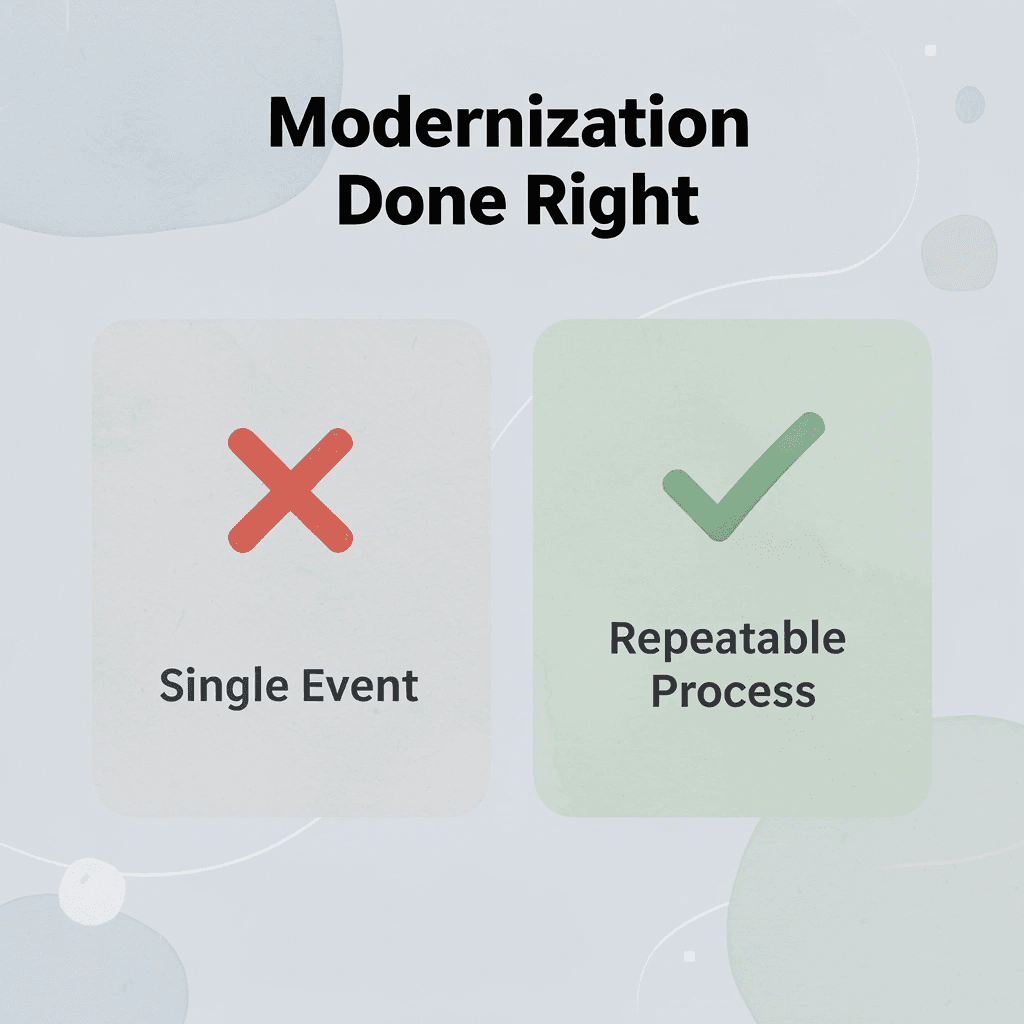
CodeGiant embodies this approach. Our Kronos LLMs don't generate code until they've fully resolved every dependency, data relationship, type, and legacy detail from the source. A lead developer who once spent months tracing RPG call stacks by hand now works from a relationship graph produced directly from the source files. The pipeline handles business logic extraction, control-flow graphs, and type mapping before conversion ever begins.
Pipeline Stage |
What It Resolves |
|---|---|
Dependency Analysis |
All inter-module and call-stack relationships |
Business Logic Extraction |
Core rules embedded in legacy RPG code |
Control-Flow Graphing |
Execution paths and branching logic |
Type Mapping |
Data types and legacy field definitions |
💡 Tip: The Kronos pipeline front-loads all resolution work before a single line of modern code is written—eliminating the rework cycles that derail most modernization projects.
✅ Best Practice: Require full dependency and type resolution as a mandatory gate before any code generation begins. This is the CodeGiant standard—and it's what separates predictable delivery from costly surprises.
What happens to the knowledge nobody wrote down?
The failure point is usually not the code itself, but the decision logic only one person understood, the pricing quirk that lived in one developer's memory for fifteen years, or the discount rule that never made it into a specification document. When that person retires, the rule does not disappear from production; it becomes invisible to everyone responsible for maintaining it.
How does RPG Modernization recover logic that was never documented?
CodeGiant has an automated tool that extracts business rules from source code and presents them in a format accessible to developers unfamiliar with 5250 terminals. This preserves the company's knowledge when experienced workers retire, preventing critical expertise from walking out the door.
Why does extracted logic reflect what the system actually does rather than what anyone thought it did?
CodeGiant handles this differently than traditional knowledge-transfer sessions: it creates relationship graphs from source files and runs type verification before conversion, so the extracted logic shows what the system actually does rather than what anyone thought it did. That difference matters when the converted service handles payroll calculations or regulatory reporting, where a single missed condition creates a compliance exposure.
Does modernization have to mean disruption?
According to the Red Hat State of Application Modernization Report, 71% of organizations say application modernization is extremely or very important to their business strategy, yet fewer than 60% have a formal strategy in place. This gap reflects fear of disruption masked as a resourcing problem. The same report finds that 54% of organizations cite legacy application modernization as a top IT priority over the next 12 months. The pressure to act is real, but so is the risk of acting carelessly.
How does RPG Modernization keep production running during conversion?
CodeGiant's file chunking and automated conversion pipeline processes IBM i source in controlled units, allowing production to continue running on current programs while pieces move through the pipeline. A small IBM i team makes progress without risking payroll on a single weekend cutover.
What makes RPG Modernization a verified process rather than a gamble?
Conversion without verification is risk in a different container. CodeGiant treats functional and behavioral equivalence as a required gate, not an afterthought. The converted service does not ship until extracted logic matches the source's behavior—a Tuesday discount rule that compiled cleanly but calculated incorrectly would not survive the pipeline.
After go-live, an AI SRE monitors every modernized service around the clock, detecting anomalies and repairing incidents without requiring human on-call coverage. Modernization becomes an operational posture that continues long after converted code runs in production. What catches most teams off guard isn't the conversion itself, but what they discover they can build once the logic becomes accessible.
Related Reading
- Enterprise Architecture Modernization
- Iseries Modernization
- Application Modernization Benefits
- .net Modernization
- Application Modernization Roadmap
- Cobol Replacement
- Insurance Legacy Modernization
Try CodeGiant's Enterprise AI Platform Today
CodeGiant gives you a controlled way to move business-critical IBM i programs to production-ready, cloud-native services without replacing your core systems. Our Kronos LLMs map dependencies, data relationships, and legacy details before code generation — starting with precision rather than assumption.
"Map dependencies, data relationships, and legacy details before code generation — starting with precision rather than assumption." — CodeGiant Platform Principle
💡 Tip: Kronos LLMs perform deep dependency mapping upfront, so your modernization starts from a complete picture of your estate — not a best guess.
⚠️ Warning: Skipping dependency mapping before code generation is a leading cause of legacy modernization project failure. CodeGiant's Kronos LLMs eliminate this risk by design.
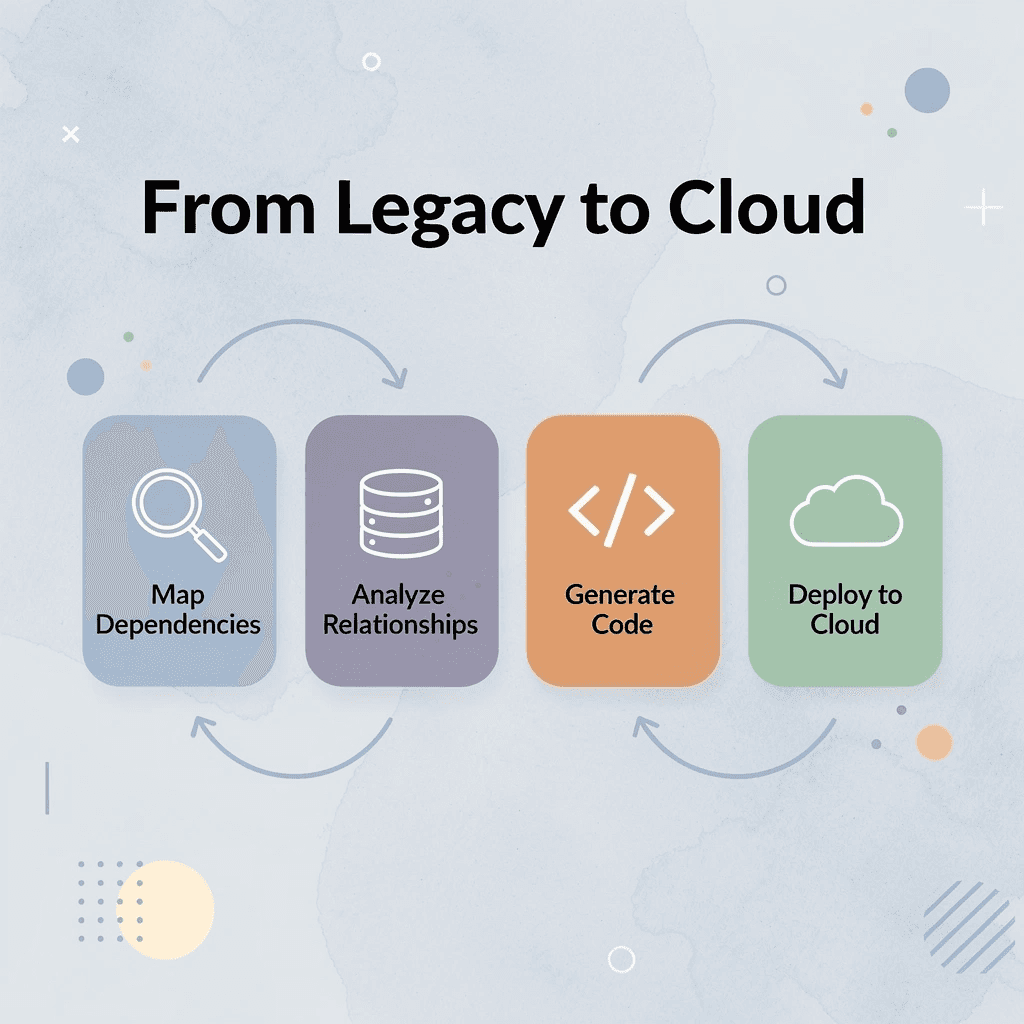
Schedule a personalized demo at CodeGiant to see your programs mapped, converted, and ready to deploy in your cloud environment. Or create an account at https://codegiant.io/users/sign_up and start right away —no lengthy onboarding required. You keep governance in your infrastructure, preserve the calculations operations trusts, and gain a clear view of modernization across your entire estate.
What You Keep |
What You Gain |
|---|---|
Governance in your infrastructure |
Cloud-native deployment readiness |
Trusted operational calculations |
Full dependency visibility |
Core IBM i business logic |
Production-ready, modernized services |
🎯 Key Point: You don't have to choose between modernization and stability — CodeGiant delivers both, preserving what operations trusts while unlocking cloud-native agility.
✅ Best Practice: Start with a personalized demo to see your specific IBM i programs mapped and converted — so you can validate CodeGiant's precision against your own estate before committing.