Many businesses still run AS400 systems, also known as IBM iSeries, because these platforms have delivered decades of reliable performance. That reliability, however, does not ease the growing pressure to reduce technical debt, modernize infrastructure, and keep pace with evolving business demands. Moving RPG code, COBOL programs, or DB2 databases into a more flexible environment requires a clear strategy and the right application modernization tools to avoid costly missteps.
The shift from legacy to modern does not have to mean months of disruptive manual rewrites. Teams that approach it methodically can preserve core business logic while accelerating cloud migration and long-term system sustainability. CodeGiant's enterprise AI platform gives development teams a structured, efficient path to convert and refactor IBM i code without interrupting daily operations.
Table of Contents
- What Is AS400 Modernization, and Why Is It Important for Enterprise IT Teams?
- What Challenges Do IT Teams Face During AS400 Modernization?
- Can AI Accelerate AS400 Modernization?
- 11 Best Practices for AS400 Modernization
- How to Choose the Right AS400 Modernization Platform
- How CodeGiant Simplifies AS400 Modernization
- Try CodeGiant's Enterprise AI Platform Today
Summary
- AS400 systems remain deeply embedded in enterprise operations, with over 95% of Fortune 500 companies still running IBM i infrastructure according to Damco Group. These platforms handle payroll, inventory, financial transactions, and production processes daily, which means modernization cannot follow a rip-and-replace approach. The goal is capability expansion, keeping what works while removing the friction that slows everything else down.
- The skills shortage around RPG and COBOL is accelerating faster than most IT roadmaps account for. Fortra's 2025 IBM i Marketplace Survey found that 60% of respondents ranked IBM i skills as a top planning concern, and fewer than 15% of IT professionals under 35 have hands-on experience with these languages. When the specialists who carry decades of undocumented business logic retire, that knowledge does not transfer automatically; it disappears unless there is a structured way to extract and preserve it before they leave.
- Maintenance costs are quietly consuming innovation budgets at a scale most organizations underestimate. Nearly half of IT decision-makers at large organizations report that actual costs to maintain legacy systems exceeded planned budgets in the past year, according to Ensono's 2025 State of IT Modernization survey. Legacy systems account for up to 80% of IT budgets in organizations still running AS400 environments, meaning the longer modernization is deferred, the less capacity remains for building anything new.
- AI is producing measurable reductions in modernization effort, not just theoretical ones. Tieto reports that AI can reduce application modernization effort by up to 40%, and IBM's internal results with its Bob tooling showed a 70% reduction in time spent on selected tasks alongside roughly 69% faster code generation and refactoring. The biggest gains come from the discovery and analysis phase, where AI can map dependencies and surface embedded business logic in days rather than the months a manual review typically requires. AWS Transform's work with Toyota Motor North America cut application discovery and planning effort by 75%, reflecting how dramatically AI changes the cost structure of the pre-conversion phase.
- Most AS400 modernization projects do not fail during code conversion. They stall before it starts (in the documentation and dependency mapping phase) and after it finishes (in the deployment and validation gap where transformed code sits ready but surrounding infrastructure has not caught up). Kyndryl's survey of 500 business and IT leaders found that only 14% of organizations reported their modernization projects as complete, with the average project consuming 3.9% of the IT budget and stretching roughly 24 months. Scope creep, incomplete test coverage, and undocumented business rules compound each other in ways that are predictable but rarely fully accounted for in initial project plans.
- Security exposure grows specifically in the connections around IBM i systems rather than in the core platform itself. Fortra's survey found 77% of IBM i users listing cybersecurity among their top five planning concerns, with legacy integration points, file transfers, and proprietary connectors representing the highest-risk pathways. Modernization addresses this by introducing current authentication standards, API gateways with proper access controls, and structured audit logging, closing gaps in the surrounding architecture rather than in the IBM i foundation itself.
- CodeGiant's enterprise AI platform helps enterprise IT teams extract and convert legacy RPG and COBOL business logic into modular, callable services that deploy directly to AWS, Azure, or Google Cloud without requiring teams to rebuild conversion work for each target environment.
What Is AS400 Modernization, and Why Is It Important for Enterprise IT Teams?
AS400 modernization updates IBM i applications, interfaces, databases, and workflows so they can work together with modern cloud services, APIs, and development practices without taking apart the core systems. It expands what your business can do—letting enterprises keep what works while removing what slows them down.
"AS400 modernization is not about replacing what's proven—it's about unlocking the full potential of existing IBM i infrastructure by connecting it to the modern technology ecosystem." — Enterprise IT Insight
🎯 Key Point: AS400 modernization is a strategic upgrade—not a rip-and-replace. Enterprises retain their battle-tested core systems while gaining access to cloud services, modern APIs, and agile development workflows.
💡 Why It Matters: Without modernization, IBM i systems become isolated from the tools your teams rely on today—creating bottlenecks, integration gaps, and competitive disadvantages that compound over time.
Component Updated |
What It Enables |
|---|---|
IBM i Applications |
Integration with modern UI frameworks and web interfaces |
Databases |
Connectivity with cloud-native data platforms and analytics tools |
Workflows |
Alignment with agile and DevOps development practices |
APIs |
Seamless communication with third-party services and microservices |
Why is the skills shortage making AS400 modernization more urgent?
In Fortra's 2025 IBM i Marketplace Survey, 60 percent of respondents ranked IBM i skills as a top concern, second only to cybersecurity. Those professionals are approaching retirement, taking decades of undocumented knowledge with them. Modernization reduces reliance on scarce expertise by introducing modern languages, tools like Visual Studio Code, and clearer code structures that newer developers learn and maintain more quickly and with less risk.
Why is the all-or-nothing approach to AS400 modernization a false choice?
The choice between "rip and replace" and "do nothing" is a false dichotomy. Companies treating modernization as all-or-nothing either overspend on risky changes or accumulate technical debt until compliance failures or talent crises force action.
What does AS400 modernization actually involve?
Modernization updates the layers on top of IBM i's proven transaction engine: replacing green-screen interfaces with browser-based or mobile front ends, exposing business logic through REST APIs, refactoring RPG and COBOL code into maintainable structures, and connecting to hybrid-cloud services without custom workarounds. The underlying database and business rules remain unchanged. The Fortra survey showed 77 percent of IBM i users listing cybersecurity among their top five planning concerns. Modernization closes these gaps by introducing current authentication methods, API gateways with proper controls, improved logging, and alignment with regulatory requirements for continuous monitoring and rapid response.
Why the skills shortage makes this urgent
The group of experienced RPG and IBM i developers is shrinking. These specialists possess deep knowledge of business rules, data structures, and company operations, yet much of this knowledge remains undocumented. When they leave, that knowledge departs with them. Fortra's 2025 IBM i Marketplace Survey found that 60 percent of respondents cited IBM i skills as a top concern when planning their IT environments, second only to cybersecurity.
How does AS400 modernization reduce dependency on retiring specialists?
Modernization reduces that dependency by introducing familiar languages and tools—Visual Studio Code, Git-based workflows, and modern testing frameworks—that a broader developer population already knows. Code becomes readable, processes become repeatable, and new team members can contribute without a six-month apprenticeship under a retiring specialist.
What happens when institutional knowledge disappears before AS400 modernization begins?
Most teams handle knowledge transfer by writing down what they can and hoping people retain important information. That works until a key person retires, and suddenly a critical payroll process becomes a mystery no one can safely touch. Our enterprise AI platform helps teams analyze, convert, and refactor legacy IBM i code in a structured way, preserving business logic while making it legible to future developers.
Why maintenance costs are the hidden tax on innovation
Nearly half of IT decision-makers at large organizations report that the actual costs of maintaining legacy systems exceeded their planned budgets in the past year, according to Ensono's 2025 State of IT Modernization survey. Every dollar spent on reactive maintenance is a dollar unavailable for new capabilities, faster integrations, or security improvements. Across financial services, manufacturing, healthcare, and government, aging hardware contracts, specialized support agreements, and manual deployment processes consume budget allocated for digital initiatives. Modernization converts that recurring expense into capacity, freeing teams from firefighting so they can focus on building.
Security gaps widen with every passing year
Old authentication methods, limited API visibility, and minimal logging create security gaps that modern threat actors actively exploit. A Fortra survey found that 77 percent of IBM i users cited cybersecurity among their top five planning concerns. This concern is well-founded: legacy integration points, file transfers, and proprietary connectors are low-visibility pathways attackers exploit when perimeter defenses are strong but internal connections are not.
Modernization introduces current authentication standards, API gateways with proper access controls, structured audit logging, and alignment with regulatory frameworks that expect continuous monitoring. The IBM i platform has strong security fundamentals; the risk lies in the aging connections around it, and modernization addresses those specifically.
Integration friction slows every initiative
When connecting an AS400 system to an analytics platform requires a custom file transfer built in 2009, every new data project starts with an archaeology project. Teams spend weeks reverse-engineering undocumented interfaces before writing new code. That friction accumulates across every project and quarter, until the backlog becomes permanent. Standard REST APIs, event-driven architectures, and hybrid-cloud connectors eliminate that starting cost. Once the IBM i system speaks a language the rest of the enterprise understands, integration timelines shrink from quarters to weeks.
What Challenges Do IT Teams Face During AS400 Modernization?
Execution is where AS400 modernization roadmaps fall apart — because of growing challenges that teams often don't realize will be that hard.
"The gap between planning an AS400 modernization and successfully executing it is where most projects stall — underestimating complexity is the #1 reason modernization roadmaps fail." — Industry Insight
⚠️ Warning: Don't mistake a well-documented roadmap for a ready team — the real difficulty of AS400 modernization only becomes clear during active execution, not planning.
💡 Tip: Before committing to a modernization timeline, conduct a deep-dive complexity audit to surface hidden technical and organizational challenges before they derail your project.
Challenge Area |
Why It's Harder Than Expected |
|---|---|
Legacy Code Complexity |
Decades of undocumented business logic buried in RPG/COBOL |
Skill Gaps |
Shrinking pool of AS400-fluent developers on the market |
Integration Dependencies |
Tightly coupled systems that break when one component changes |
Business Continuity Risk |
Zero tolerance for downtime in mission-critical operations |
🎯 Key Point: AS400 modernization is not just a technical migration — it is an organizational transformation that demands cross-functional alignment, realistic timelines, and a clear-eyed view of every challenge standing between the roadmap and the finish line.
Knowledge Loss and Undocumented Business Rules
For decades, custom RPG and COBOL logic has held critical business decisions never documented formally. When original developers retire, those rules disappear with them. Remaining staff must reverse-engineer edge cases, exception handling, and contractual exceptions buried in the code. Teams spend weeks reconstructing behavior that once existed only in one person's head. This delays every change and increases the risk that a rewritten module produces different results on real workloads. Projects stall while the business operates on systems no one fully understands. This structural problem developed over decades of shipping features faster than anyone could document them.
Why is the AS400 modernization skills shortage getting worse every quarter?
The same issue shows up in financial services, government, and manufacturing: the people who understand the system best are approaching retirement. According to ArgonDigital's analysis of AS400 risk, 70% of Fortune 500 companies still use AS400 systems, yet fewer than 15% of IT professionals under 35 have hands-on RPG or COBOL experience. The gap widens every quarter.
How does team overload slow down AS400 modernization efforts?
The few IBM i specialists still around already handle all support work for production systems. Modernization work diverts them from daily tasks and creates a backlog. New employees require extensive training on undocumented special tools and code, extending project timelines and increasing contractor costs. Most teams assign modernization work to whoever knows the most about IBM i. These individuals become bottlenecks, responsible for maintaining live systems, training staff, and advancing transformation projects simultaneously. When they leave, the project loses momentum and progress stalls.
Why do AS400 modernization integration and data migration risks run so deep?
AS400 environments store years of tightly coupled data and batch processes that resist clean extraction. Connecting them to cloud services, analytics platforms, or modern APIs requires custom interfaces that introduce delays, data-quality issues, and security gaps. Infosys's Modernization Radar survey of 1,500 senior technology leaders found that 51 percent cited a lack of skills and talent as a greater pain point than the risk of disruption or modernization costs, indicating that integration complexity is both a technical and a human capacity constraint. During migration, small discrepancies in data lineage or timing create reconciliation failures that surface only after go-live, forcing emergency fixes and eroding trust in the new environment.
How can AS400 modernization reduce data migration errors without full replacement?
Platforms like CodeGiant solve this problem by letting teams build production-grade APIs and automations on top of the existing IBM i stack instead of replacing it. This keeps core business logic safe while making it available to modern cloud services, reducing the risk of data migration errors.
Scope Creep, Testing Burdens, and Project Overruns
The full web of dependencies only becomes visible once work begins. Kyndryl's survey of 500 business and IT leaders identified insufficient expertise, scope creep, and testing demands as top modernization challenges, with only 14 percent of organizations reporting project completion. The average project consumes 3.9 percent of the IT budget and takes roughly 24 months. Each missed dependency increases those figures. Incomplete test coverage leaves critical paths unvalidated, while late-discovered performance issues force unscoped rework. This is the predictable result of modernizing systems whose full behavior was never documented.
Operational Disruption and Continuity Threats
If the live system processes thousands of transactions daily, any change to core logic carries real risk. Teams must keep production stable while testing new components under realistic loads. When hardware or software versions fall behind, replacement parts become scarce and recovery times lengthen, turning a controlled modernization window into an extended outage that damages customer relationships and triggers compliance scrutiny. The binary choice between "rip and replace" and "do nothing" is false. Enterprises that extend their existing IBM i foundation rather than replacing it preserve operational continuity while advancing toward modern architecture.
Budget Pressure and Rising Long-Term Costs
Spending money upfront on analysis, tools, and dual environments competes with the costs of ongoing maintenance. Delaying modernization increases the eventual price: specialized support rates climb, hardware reaches end-of-support, and technical debt accumulates faster than teams can address it. Maintenance already crowds out innovation, and postponed decisions compound costs and risk.
How do compounding barriers affect AS400 modernization planning?
These challenges reinforce one another: skills shortages slow documentation recovery, which inflates testing needs, which drives scope creep, which stretches budgets and heightens disruption risk. Enterprise IT teams that recognize the full weight of these barriers can plan realistic roadmaps rather than underestimating required effort. What nobody discusses enough is what happens when a new technology enters the picture and promises to change the equation entirely.
Related Reading
- Application Modernization Tools
- What Is Application Modernization
- How To Modernize Legacy Systems
- Build Internal Tools
- Cobol Modernization
- Mainframe To Cloud Migration
- Legacy Software Modernization
- Cobol To Java
- Technical Debt Management
- Ai Governance
- Legacy System Modernization
Can AI Accelerate AS400 Modernization?
AI speeds up AS400 modernization across every critical dimension: analysis, documentation, code conversion, and testing. According to Tieto, AI can reduce application modernization effort by up to 40%, a figure consistently supported by IBM i evidence.
"AI can reduce application modernization effort by up to 40% — a figure consistently supported by IBM i evidence." — Tieto, 2026
🔑 Takeaway: A 40% reduction in modernization effort is not marginal. It represents the difference between a multi-year overhaul and an achievable transformation timeline.
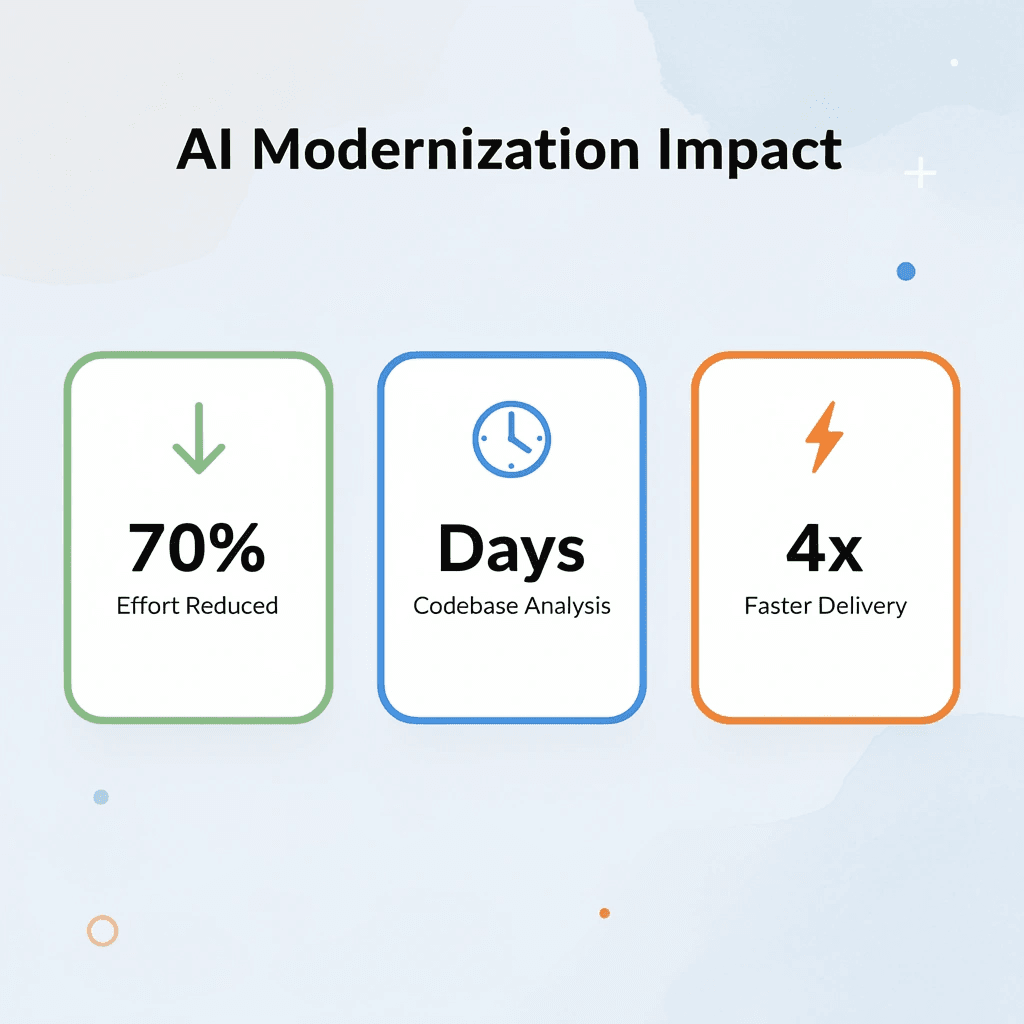
The real speed boost comes from eliminating the traditional bottleneck: the weeks and months spent mapping system behavior before conversion even begins. AI models trained on RPG, COBOL, and CL can read through entire codebases in days, creating dependency maps and plain-English descriptions of business logic that would otherwise require retired specialists to rebuild from memory. This removes the longest delay in most modernization roadmaps.
💡 Tip: Prioritize AI-assisted codebase analysis as your first modernization step — unlocking this speed advantage early compresses your entire project timeline.
⚠️ Warning: Without AI-driven documentation, teams risk critical knowledge gaps when the institutional memory of legacy RPG and COBOL systems walks out the door with retiring staff.
Traditional Approach |
AI-Accelerated Approach |
|---|---|
Weeks to months of manual codebase analysis |
Days to map entire codebases |
Dependency on retired specialists |
AI models trained on RPG, COBOL, and CL |
Slow, memory-dependent documentation |
Automated plain-English business logic descriptions |
Longest delay baked into roadmap |
Bottleneck eliminated before conversion begins |
What changes when AI reads your RPG code
The critical difference is not speed alone but precision at scale. When an AI model analyses a 30-year-old RPG III program, it identifies dead code, surfaces embedded business rules, and flags logic branches that manual reviewers would miss after hours of reading fixed-format source. That systematic attention does not tire.
How do purpose-built AS400 modernization tools change what a team can deliver?
Special tools made for this job, like IBM's Bob and Fresche's X-Modernize AI, work with structured dependency graphs instead of raw source files. This creates candidate code that shows how the program actually works rather than matching surface-level patterns. IBM's internal results showed a 70 percent reduction in time spent on selected tasks and 69 percent faster code generation and refactoring work: a change that transforms what a team of five can accomplish in a quarter.
How AI changes the testing equation
Testing is where AS400 modernization projects most often get stuck after conversion. Checking that refactored RPG or a Java equivalent works the same way as the original system requires comparing outputs across thousands of transaction scenarios. Manual checking against mission-critical systems running payroll or inventory is slow, expensive, and risky.
How does AI-driven testing keep AS400 modernization on track?
AI creates test suites by using the same code understanding it builds while analyzing. Teams input the original system's data into new components and compare results automatically, catching behavioral differences before production. This enables continuous validation instead of periodic manual review, transforming what used to be a high-stakes "big bang" cutover into incremental, auditable steps.
Why does manual comparison testing create a bottleneck for AS400 modernization teams?
Most teams assign their best IBM i specialists to run comparison tests manually while maintaining production stability. As modernization scope grows, this creates a bottleneck: the same people responsible for production support must also validate the new system. Our CodeGiant enterprise AI platform embeds governance and automation into the modernization process, allowing enterprises to extend and transform their IBM i stack without diverting specialists from critical work.
The cost math that actually changes
Precisely's 2025 AI-driven capabilities signal a fundamental shift: AI is now integral to modernization architecture, not an optional add-on. This significantly impacts overall project costs.
How does AI reduce the cost of discovery for AS400 modernization?
Discovery and planning traditionally consume 40 to 60 percent of total modernization project cost. AWS Transform's work with Toyota Motor North America cut application discovery and planning effort by 75 percent. When AI removes the manual inventory phase, specialists focus on decisions requiring judgment rather than routine tasks. The economics of AS400 modernization changed because tools now match the actual complexity of these systems, a fundamentally different starting point than three years ago. What happens when those tools meet the specific constraints of a regulated enterprise environment is where the real test begins.
Related Reading
- As400 Modernization
- Enterprise Ai Governance
- Public Sector Digital Transformation
- Mendix Alternatives
- OutSystems Alternatives
- Appian Pricing
- Ai Agent Pricing
- Outsystems Vs Mendix
11 Best Practices for AS400 Modernization
AS400 modernization works better with a clear strategy instead of rushed upgrades. Looking at your environment, focusing on business value, and modernizing in phases reduces critical risk while keeping IBM i reliability intact. The following best practices help organizations modernize without disrupting critical operations.
"Organizations that modernize with a phased, strategy-first approach consistently outperform those that pursue rushed, all-at-once upgrades — preserving reliability while accelerating transformation." — IBM i Modernization Industry Insight
💡 Tip: Before writing a single line of new code, always audit your existing AS400 environment — understanding what you have is the essential first step to a successful modernization roadmap.
⚠️ Warning: Skipping a phased modernization plan is one of the most common — and costly — mistakes organizations make. Rushed upgrades risk operational disruption, data integrity issues, and unexpected downtime across critical systems.
Modernization Approach |
Risk Level |
Business Continuity |
|---|---|---|
Rushed, all-at-once upgrade |
🔴 High |
Frequently disrupted |
Phased, strategy-first modernization |
🟢 Low |
Consistently maintained |
No modernization (status quo) |
🟡 Medium |
Stable but declining |
🔑 Takeaway: AS400 modernization is not a single event — it's a structured journey built on clear strategy, phased execution, and an unwavering focus on business value at every step.

1. Conduct a Complete System Assessment and Inventory
Make a list of all RPG programs, CL procedures, DDS files, database objects, job schedules, and external interfaces. Examine how these components are used by reviewing job logs and call graphs to identify unused code and high-risk modules. This inventory prevents surprises about required changes and enables leaders to prioritize components by business criticality, technical debt, and dependencies.
2. Align Goals Directly with Business Outcomes
Set clear goals like faster order-to-cash cycles, shorter onboarding time for new users, or real-time data feeds for analytics. Score each work area by impact, effort, and risk to prioritize changes that free up capacity or remove bottlenecks. Clear outcome metrics tie technical work to revenue and operational goals.
3. Commit to a Phased, Incremental Roadmap
Break the work into sequential steps: assessment, pilot, expansion, and optimization, instead of replacing everything at once. Each step delivers working features while preparing for the next phase. This limits risk, builds confidence, and enables adjustments based on actual results.
4. Rebuild Knowledge Directly from the Code
Create current documentation by examining source code, extracting business rules, and mapping dependencies. Use the living code as the source of truth rather than outdated manuals. Automated analysis tools identify undocumented edge cases and decision logic, ensuring new team members and future maintainers access accurate information instead of tribal knowledge that vanishes when people leave.
5. Secure Early Wins with High-Impact, Low-Risk Changes
Focus on green-screen interfaces, report generation, or simple inquiry functions for the first releases. Convert 5250 screens to modern web or mobile front ends and make stable programs available as APIs. These visible improvements demonstrate value quickly, free specialists from repetitive support, and build momentum for longer, deeper modernization work.
6. Modernize the Database Layer First
Change DDS-defined files into SQL tables with appropriate constraints, indexes, and referential integrity. This improves query performance, enables modern analytics tools to access data directly, and reduces maintenance work. Teams that complete this migration early establish a stable foundation for subsequent application changes without having to repeat data-mapping work.
7. Refactor Code into Free-Format and Modular Structures
Move fixed-format RPG III and RPG IV programs to free-format RPGLE and break large routines into smaller, reusable service modules. Modular design separates business logic, simplifies unit testing, and improves readability for developers unfamiliar with older dialects. This lowers the skill barrier for new team members and prepares components for API exposure or selective replacement.
8. Expose Core Functions Through Standard APIs
Wrap proven RPG and COBOL programs with REST or other industry-standard interfaces so modern applications, mobile clients, and cloud services can call them directly. API enablement preserves original transaction logic while eliminating integration friction that previously required manual workarounds. Each published service becomes a permanent bridge supporting hybrid architectures and future innovation.
9. Introduce Modern Development Tooling and DevOps Practices
Use Visual Studio Code with IBM i extensions, Git for source control, and automated build-and-deploy pipelines. These tools replace legacy SEU and PDM workflows with collaborative, versioned processes that support continuous integration, shorten feedback loops, reduce deployment errors, and align IBM i development with enterprise practices.
10. Embed Security, Testing, and Parallel Validation from Day One
Use current authentication, encryption, and object-level security controls in every modernization wave. Create automated regression suites that compare original system outputs with new components using identical inputs, running both environments in parallel until the results consistently match. This validation protects uptime and compliance while providing stakeholders clear proof that the modernized path is safe.
11. Preserve Institutional Knowledge and Build Skills Continuously
Capture the knowledge of retiring specialists through structured knowledge-transfer sessions, recorded walkthroughs, and AI-assisted documentation. Pair IBM i experts with newer developers on each modernization wave so skills transfer occurs through real work. Maintain a living knowledge base that includes decision rationales, edge-case handling, and operational procedures. This ensures the organization retains control of its core systems as the original talent pool shrinks. These eleven practices form a complete, risk-managed path to convert an aging but reliable platform into a flexible foundation supporting current business demands while preserving the stability that made AS400 systems valuable.
How to Choose the Right AS400 Modernization Platform
Choosing an AS400 modernization platform is critical. The right platform speeds up modernization, reduces technical debt, makes integrations simpler, and gets IBM i applications ready for cloud, AI, and future business needs. The wrong choice creates vendor lock-in, increases migration costs, and limits your ability to grow and change. Evaluating platforms against clear technical and business criteria makes sure your modernization investment delivers long-term value.
"The right AS400 modernization platform doesn't just migrate your system — it eliminates technical debt, unlocks cloud readiness, and positions your IBM i applications for long-term growth."
💡 Tip: Before committing to any platform, map your current technical debt and integration requirements first — this single step prevents the most costly modernization mistakes.
⚠️ Warning: Choosing the wrong platform can result in vendor lock-in and skyrocketing migration costs that derail your entire modernization roadmap.
Evaluation Criteria |
Right Platform |
Wrong Platform |
|---|---|---|
Modernization Speed |
Accelerated delivery |
Slow, costly rollouts |
Technical Debt |
Actively reduced |
Carried forward or worsened |
Integration Complexity |
Simplified and streamlined |
Fragmented and expensive |
Cloud & AI Readiness |
Built-in support |
Requires costly add-ons |
Vendor Lock-in Risk |
Low — open standards |
High — proprietary dependencies |
Long-Term Value |
Strong ROI |
Diminishing returns |
🎯 Key Point: Evaluating platforms against both technical criteria (cloud readiness, integration support) and business criteria (cost, scalability, vendor flexibility) is the only way to ensure your modernization investment pays off long-term.

Assess Native IBM i and RPG Compatibility
Focus on platforms that work directly with RPG, COBOL, CL, DDS, and Db2 for i, rather than requiring a complete translation to another language. Native support lets teams keep trusted transaction logic intact while adding modern interfaces or APIs. Platforms that force early conversion increase the risk of missing edge cases and validation effort. Confirm the tool can read all RPG dialects in your codebase and create accurate dependency maps before transformation begins.
Evaluate API Enablement and Integration Capabilities
Today's businesses need to connect immediately to cloud services, mobile apps, and analytics platforms. The platform you choose must create secure REST or similar APIs from existing programs without rewriting code. Look for built-in support for JSON handling, authentication standards, and easy endpoint deployment. Strong API features transform the AS400 into a service provider that other systems can call, eliminating the need for file transfers and screen scraping.
Examine Automation and AI-Assisted Analysis Features
Manually finding and documenting legacy code requires significant time and specialized skills. Platforms that automatically extract business rules, identify unused code, map function dependencies, and generate plain-English descriptions accelerate project initiation. AI tools that support refactoring and test creation save time while preserving the integrity of the logic. Test the platform's accuracy on a sample of your actual programs to ensure it reduces manual review work, not increases it.
Confirm Security and Compliance Controls
Every modernization step expands the attack surface if security is treated as an afterthought. Require platforms that enforce role-based access, encrypt data in transit and at rest, support multi-factor authentication, and produce auditable logs. The tool should integrate with existing enterprise security frameworks and maintain IBM i's object-level security model.
Verify Hybrid and Cloud Readiness
Most organizations keep some workloads on IBM Power while moving others to cloud or distributed environments. The platform must support hybrid deployments, data synchronization, and seamless connectivity between on-premises IBM i and external services. Confirm the solution works with your preferred cloud providers and avoids proprietary formats that lock in data or logic.
Review Vendor Expertise and Proven Track Record
Choose providers with substantial experience working with IBM i, not companies that handle many different types of modernization work. Ask for case studies demonstrating successful projects similar to yours, with clear results such as reduced maintenance time or faster release cycles. Select providers capable of managing the full scope from initial assessment through post-launch support, not just a single tool. Ensure they employ strong knowledge transfer practices so your internal teams develop lasting skills rather than remaining dependent on external support.
Align the Platform with Strategic Approach and Total Cost
Match the tool to your chosen path: UI modernization, selective refactoring, full re-architecture, or hybrid. Calculate total cost of ownership, including licenses, training, parallel-run infrastructure, and ongoing maintenance, against expected timeline reduction and risk reduction. Platforms that deliver early wins while supporting longer-term goals produce better returns. Run a limited pilot on non-critical modules to validate fit before committing enterprise-wide. The right platform becomes a force multiplier that protects AS400 stability while removing isolation barriers. Teams that evaluate candidates against these criteria avoid costly mismatches and move forward with confidence.
How CodeGiant Simplifies AS400 Modernization
Regulated enterprises face competing pressures: AS400 environments must run without interruption, compliance requirements don't pause for migration timelines, and the business demands modern capabilities now.
"Regulated enterprises face a critical trilemma — operational continuity, compliance adherence, and modernization speed must all be achieved simultaneously, with zero margin for failure."
💡 Tip: The key to navigating AS400 modernization is choosing a platform that treats uptime, compliance, and agility as non-negotiable — not competing trade-offs.
Pressure |
Business Impact |
CodeGiant's Solution |
|---|---|---|
Uninterrupted AS400 operations |
Downtime costs revenue and trust |
Zero-disruption migration pathways |
Compliance requirements |
Regulatory penalties and audit risk |
Built-in compliance guardrails |
Demand for modern capabilities |
Competitive disadvantage |
Rapid modernization tooling |
⚠️ Warning: Attempting AS400 modernization without a structured platform that addresses all three pressures simultaneously is one of the most common — and costly — mistakes regulated enterprises make.

Why do AS400 modernization workarounds make systems harder to manage?
Most teams treat the AS400 as a black box, building workarounds and extra layers of software around it instead of modifying the core system. As these workarounds accumulate, the system becomes harder to extend, audit, and explain to regulators. The original reliability gets buried under layers of compensating architecture that nobody fully understands.
How much do legacy AS400 environments cost organizations each year?
According to Keyhole Software's Legacy Modernization Trends research, legacy systems consume up to 80% of IT budgets in organizations using AS400 environments. Organizations spend this money not because systems work perfectly, but because complexity management worsens each year without a clear modernization plan.
Where the conversion process actually breaks down
The failure point in most AS400 modernization projects isn't the code conversion itself: it's what happens before and after. Before conversion, teams spend months mapping dependencies, tracing embedded business logic, and building documentation that should have existed for decades. After conversion, transformed code sits ready, but the surrounding infrastructure, approvals, and compliance checks haven't caught up.
How does AS400 modernization handle pre-conversion complexity?
CodeGiant's modernization pipeline addresses both gaps. Automated logic extraction, dependency resolution, and type verification occur before conversion begins, eliminating the need for teams to reverse-engineer RPG or COBOL rules manually. Our platform builds relationship graphs directly from source files, preserving the decision logic that makes those systems valuable.
What closes the post-conversion deployment gap in AS400 modernization?
An enterprise AI platform like CodeGiant closes the post-conversion gap with one-click deployment to AWS, Azure, and Google Cloud. Our platform eliminates manual handoffs and separate tools that typically extend timelines by weeks, while keeping the migration path flexible without requiring teams to rebuild conversion work for each target environment.
What separates AS400 modernization from true legacy transformation?
The critical difference between legacy modernization and legacy transformation is the outcome. Modernization that stops at code conversion gives you the same logic in a newer language. Transformation provides modular components that new applications, APIs, and AI agents can call directly without altering the original business rules.
How does AS400 modernization protect regulated business logic?
This difference is important in regulated industries. A financial services company running payment processing logic on AS400 cannot afford to rewrite those rules, yet cannot leave them locked inside a system that no modern interface can reach. The answer is a conversion pipeline that extracts the logic, wraps it in callable services, and deploys it into a governed environment where every change remains auditable.
Why are AS400 systems still at the core of critical operations?
DevOps.com reports that 70% of Fortune 500 companies still use mainframe systems such as the AS400 for critical operations. These aren't unusual systems; they're the operational centers of industries where compliance failures or data integrity issues carry regulatory and financial consequences that far exceed modernization costs.
Building new capabilities on the modernized foundation
Once core business logic exists as modular, production-ready services, development teams can build new interfaces without waiting for integration projects. AI agents can call transaction logic directly, and automated workflows can trigger processes that previously required manual intervention.
How does AS400 modernization shift the system from constraint to foundation?
That shift from locked-in logic to callable services is where modernization generates return rather than consuming budget. The AS400 stops being a constraint and becomes the capable foundation it always was. The reliability and precision that made those systems irreplaceable becomes accessible. The question isn't whether this approach works in theory, but whether it holds up under your organization's specific constraints.
Related Reading
- Enterprise Architecture Modernization
- Rpg Modernization
- Iseries Modernization
- Application Modernization Benefits
- .net Modernization
- Application Modernization Roadmap
- Cobol Replacement
- Insurance Legacy Modernization
Try CodeGiant's Enterprise AI Platform Today
Does your current AS400 modernization path give your team more control, or less? If it feels like a choice between disruption and stagnation, that framing is the problem worth solving first.
"The real modernization question isn't whether to change: it's whether your path forward gives you more control or quietly takes it away." — CodeGiant
💡 Tip: If your modernization strategy forces you to choose between operational disruption and standing still, you're likely missing a critical third option.

CodeGiant gives enterprise IT teams a concrete third path — extending IBM i environments into production-ready applications, AI agents, APIs, and automated workflows without replacing the business logic your operations depend on. Our platform deploys directly into your own cloud environment — AWS, Azure, Google Cloud, or others — so governance and infrastructure control stay exactly where they belong: with your team. Schedule a personalized demo and see what your AS400 environment can become when your foundation finally gets the tools it deserves.
Deployment Option |
Control Stays With You |
No Rip-and-Replace |
|---|---|---|
AWS |
✅ Yes |
✅ Yes |
Azure |
✅ Yes |
✅ Yes |
Google Cloud |
✅ Yes |
✅ Yes |
Other Cloud Environments |
✅ Yes |
✅ Yes |
🎯 Key Point: CodeGiant preserves your existing IBM i business logic while unlocking AI agents, APIs, and automated workflows — no core system replacement required.
✅ Best Practice: Deploy into your own cloud infrastructure to ensure full governance control and eliminate third-party data exposure risks.