Government agencies face mounting pressure to modernize public services, reduce inefficiencies, and meet rising citizen expectations, all while working within tight budgets and aging legacy systems. Application modernization tools have become central to how public sector organizations upgrade infrastructure and deliver digital services that genuinely work for people. Getting this right requires more than good intentions; it demands a clear strategy and the right technology.
Progress accelerates when agencies have a reliable platform supporting their modernization efforts. Teams that streamline workflows and reduce friction across disconnected systems can move faster, make better decisions, and deliver stronger outcomes for citizens. For public sector organizations ready to close the gap between ambition and execution, a purpose-built enterprise AI platform provides the foundation to make that shift.
Table of Contents
- What Is Public Sector Digital Transformation and Why Is It Important?
- What Challenges Slow Public Sector Digital Transformation?
- What Role Does AI Play in Public Sector Digital Transformation?
- 11 Best Practices for Public Sector Digital Transformation
- How to Measure the Success of Public Sector Digital Transformation
- How CodeGiant Accelerates Public Sector Digital Transformation
- Try CodeGiant's Enterprise AI Platform Today
Summary
- Public sector digital transformation is a massive and accelerating global priority, not a future aspiration. The government digital transformation market is expected to reach $1.07 trillion by 2030, and well-designed digital services can reduce delivery costs by up to 90% compared to traditional in-person interactions. At population scale, that cost difference redirects significant public funding toward hospitals, schools, and infrastructure rather than administrative overhead.
- Legacy system dependency is one of the most persistent structural barriers agencies face. In the UK, legacy systems make up 28% of the central government technology estate, with some organizations, such as police forces and NHS trusts, running legacy infrastructure at rates between 60% and 70%. Maintaining these systems costs three to four times as much as modern alternatives, locking agencies into patchwork repairs and leaving them exposed to growing cybersecurity risks.
- Fragmentation across government bodies creates a hidden tax on citizens and staff alike. When agencies operate as separate entities with no shared standards, people must navigate dozens of disconnected systems to complete basic tasks. The average adult in the UK spends a week and a half every year managing government bureaucracy, and public satisfaction with services has fallen from 79% to 68% over the past decade as a direct result.
- Skills gaps compound every other challenge. In a World Bank survey of more than 16,500 civil servants across 28 Malaysian ministries, 71% wanted AI training yet only 52% had received it, and fewer than one-third felt they had sufficient digital training to perform their roles effectively. In the UK, contractors and external providers account for 55% of the 26 billion pound annual digital spend, three times the cost of permanent staff, meaning institutional knowledge routinely walks out the door with each completed project.
- AI adoption in government is no longer experimental. Over 60% of governments globally have adopted or are actively piloting AI-based digital transformation initiatives, and AI-driven processes can reduce administrative processing time by up to 40%. The agencies seeing real results are not the ones with the newest infrastructure, but the ones layering intelligence onto existing systems through APIs and integrations rather than full replacements.
- Data silos remain the most stubborn technical barrier to connected public services. Only 27% of UK respondents in the State of Digital Government Review said their data infrastructure provides a comprehensive operational view, and just 4% of government services are rated "great" for digital experience. When data cannot flow between agencies, automation, fraud detection, and proactive citizen services all remain out of reach regardless of how much modernization investment has been made.
- CodeGiant's enterprise AI platform addresses this directly by enabling government technology teams to build production-grade applications, agents, and automations on top of their existing infrastructure, with built-in compliance and audit controls from the start rather than retrofitted after deployment.
What Is Public Sector Digital Transformation and Why Is It Important?
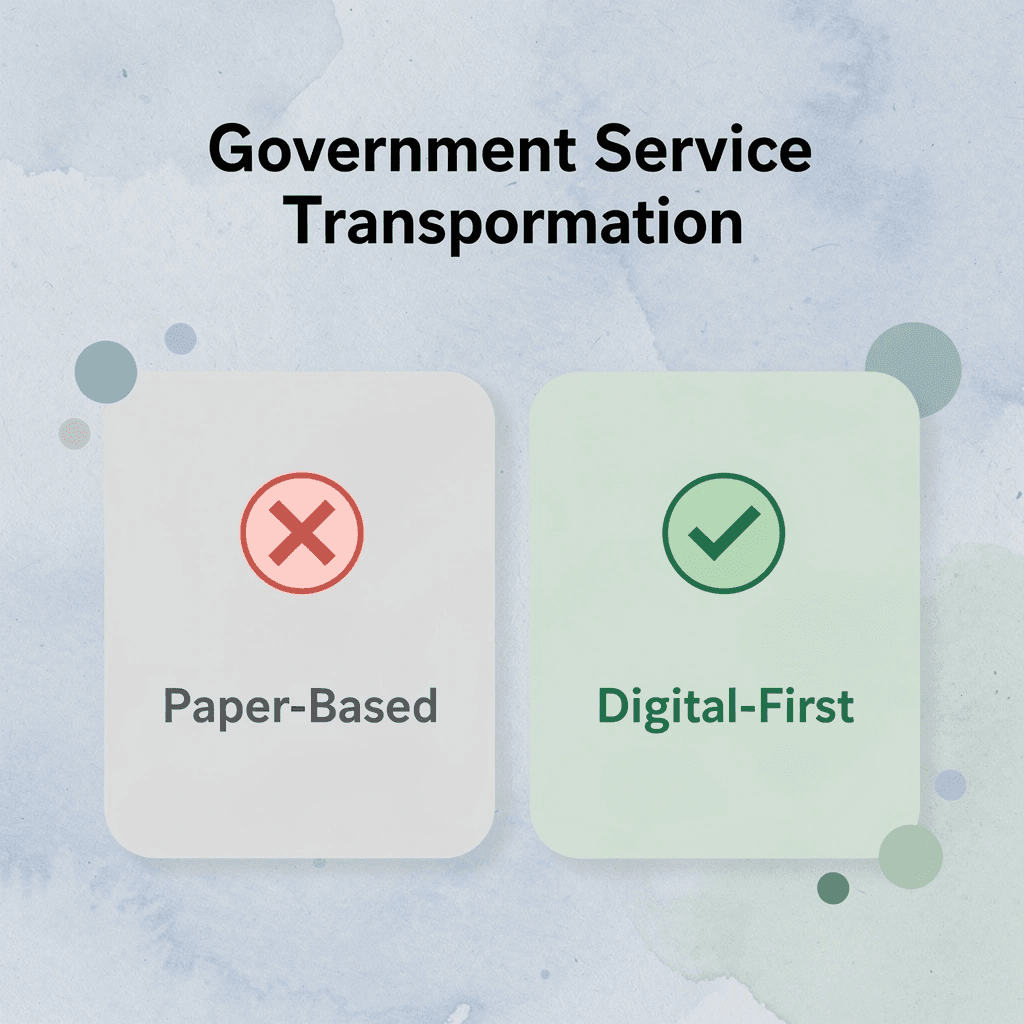
Public sector digital transformation is when government intentionally moves from paper-based, separated operations to connected, digital-first systems that serve citizens faster, more accurately, and at lower cost. It means redesigning entire service workflows, sharing data across agencies, and building the infrastructure that lets government operate like a modern institution rather than a legacy one.
💡 Definition: Public sector digital transformation is the deliberate shift from fragmented, manual government processes to integrated, digital-first systems built to serve citizens faster, smarter, and at lower cost.
🎯 Key Point: This isn't about adding technology; it's about redesigning how government works from the ground up, connecting agencies and eliminating inefficiencies embedded in legacy operations.
"The government digital transformation market is expected to reach $1.07 trillion by 2030, reflecting how seriously nations are investing in modernizing public infrastructure." — Coursera Enterprise Articles
According to Coursera Enterprise Articles, the government digital transformation market is expected to reach $1.07 trillion by 2030, reflecting how seriously nations are investing in modernizing public infrastructure. This represents built-up pressure from rising citizen expectations, budget constraints, and the growing gap between what government delivers and what people actually need.
Driver of Transformation |
What It Means |
|---|---|
Citizen Expectations |
People expect digital-first, on-demand services |
Budget Constraints |
Governments must do more with less |
Legacy Infrastructure Gap |
Old systems can't meet modern service demands |
⚠️ Warning: Nations that delay digital transformation risk falling further behind — the gap between citizen expectations and government delivery only widens without deliberate investment.
Why does public sector digital transformation stall despite genuine intent?
Governments announce transformation initiatives with genuine intent, but execution stumbles when agencies treat modernization as a technology procurement exercise rather than service redesign. They buy new software, layer it atop broken processes, and wonder why nothing improves. Most agencies attempt large-scale replacements of legacy systems, which is expensive, risky, and slow. Teams that build new capabilities directly on top of existing infrastructure move faster and maintain the governance standards public sector work demands. Our enterprise AI platform is built around this philosophy, helping agencies modernize without the operational risk of starting from scratch.
What cost and accountability gains does public sector digital transformation deliver?
Digital government services can reduce costs by up to 90% compared to traditional in-person services. A well-designed digital option costs as little as 10 cents per dollar spent on a face-to-face transaction. At the population level, that difference can fund hospitals, schools, and infrastructure.
What makes transformation important is accountability. When services run on digital systems with clear audit trails, open data, and real-time performance dashboards, citizens can see whether government is working. That transparency rebuilds trust that years of unclear, paper-based bureaucracy had damaged. But knowing why transformation matters is only part of the picture. The harder question is why, even with this much urgency and investment, so many efforts stall before reaching the people they were meant to serve.
What Challenges Slow Public Sector Digital Transformation?
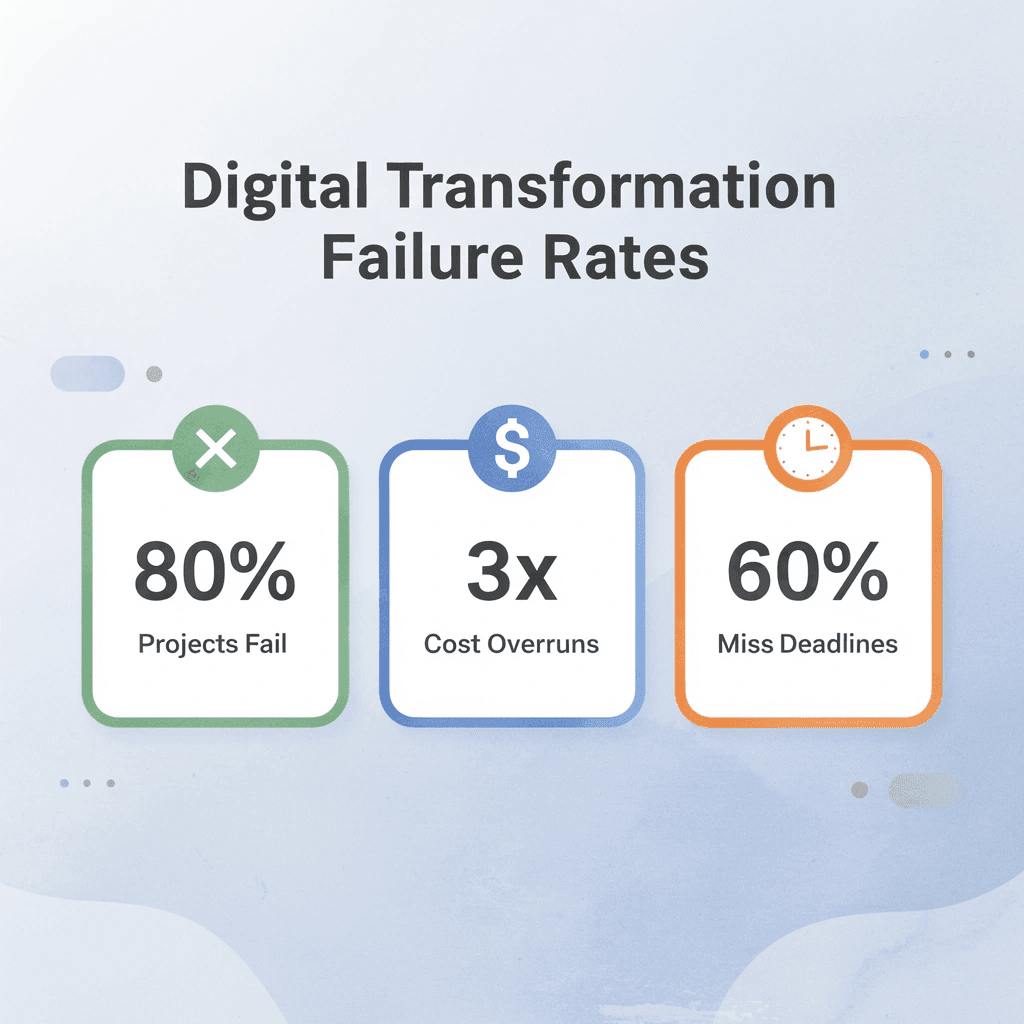
Nearly 80% of public-sector digital transformations fail, according to LinkedIn Pulse. The problems are not accidental — they are structural, cultural, and deeply rooted in how government organizations work.
"Nearly 80% of public-sector digital transformations fail — a crisis driven by structural barriers, cultural resistance, and the fundamental way government organizations operate." — LinkedIn Pulse
🔑 Takeaway: A failure rate of nearly 80% means the odds are stacked against public-sector agencies from the start — making it critical to understand and address the root causes before launching any digital initiative.
⚠️ Warning: These failures are rarely about technology alone. The real obstacles — entrenched bureaucracy, legacy mindsets, and underfunded change management — are the true drivers of transformation collapse.
Challenge Category |
Key Barrier |
Impact on Transformation |
|---|---|---|
Structural |
Siloed departments & rigid hierarchies |
Slows decision-making and cross-agency collaboration |
Cultural |
Resistance to change among staff |
Undermines adoption and long-term success |
Operational |
Legacy systems & outdated processes |
Creates technical debt and integration failures |
💡 Tip: Agencies that proactively invest in change management, stakeholder alignment, and phased rollouts dramatically improve their chances of beating the 80% failure statistic.
Legacy systems cost more than money
Old technology from decades ago still powers critical government operations, forcing agencies to spend resources maintaining these systems rather than modernizing them. In the United Kingdom, legacy systems comprise 28% of technology in central government departments, up from 26% the previous year, whilst levels in police forces and NHS trusts range from 10% to 60–70% depending on the organization. Maintaining these systems costs three to four times as much as newer alternatives, consuming budgets with constant repairs and leaving the riskiest legacy systems underfunded. This results in slower services, higher long-term costs, and growing cybersecurity risks that citizens experience directly when systems fail or data is lost.
Why does fragmentation make simple tasks so complicated for citizens?
Independent agencies build and run their own technology systems with almost no shared standards, resulting in a confusing mix of disconnected platforms that citizens must navigate on their own. The UK's 2025 State of Digital Government Review identifies structural fragmentation as a core root cause: public bodies operate as separate entities with limited ways to share services, so most create duplicate systems for common needs such as identity verification or payments.
Someone relocating must contact ten separate organizations. Managing a long-term health condition requires interaction with more than 40 services across nine different bodies. The average adult spends a week and a half every year navigating this bureaucracy, while public satisfaction with services has fallen from 79% to 68% over the past decade.
How can Public Sector Digital Transformation bridge siloed systems without a full rebuild?
Most agencies respond by building another standalone system, which worsens the problem. Platforms designed to add new capabilities on top of existing infrastructure can connect separated systems through APIs and automations without requiring a complete rebuild. This approach preserves institutional knowledge, reduces procurement risk, and maintains compliance requirements. Our enterprise AI platform at CodeGiant is built for government contexts and bridges those gaps incrementally, moving from experimentation to production without forcing agencies to abandon what already works.
Skills gaps run deeper than hiring
Public organizations lack the digital skills to design, build, and maintain modern systems, leaving them dependent on expensive contractors and unable to retain institutional knowledge. In a World Bank survey of 16,500+ civil servants across 28 Malaysian ministries, 71% wanted AI training yet only 52% received it, with fewer than one-third reporting sufficient digital training for their roles. In the UK, contractors account for 55% of the £26 billion annual digital spend—three times the cost of permanent staff. Projects stall, knowledge departs with departing staff, and capability gaps resurface with each new initiative.
Data stays locked when trust breaks down
Technical incompatibility, legal restrictions, and information hoarding keep data locked inside individual agencies even when sharing is legally permitted. Only 27% of UK respondents in the State of Digital Government Review said their data infrastructure provides a comprehensive operational view, and 70% reported that data landscapes lack coordination and a single source of truth. Without reliable data flow, automation, fraud detection, and proactive citizen services remain unavailable. According to Open Access Government, only 4% of government services are rated "great" for digital experience—a direct result of data silos that prevent services from connecting to form coherent, useful systems. Solving the data problem often reveals a harder challenge beneath it.
Related Reading
- Application Modernization Tools
- What Is Application Modernization
- How To Modernize Legacy Systems
- Build Internal Tools
- Cobol Modernization
- Mainframe To Cloud Migration
- Legacy Software Modernization
- Cobol To Java
- Technical Debt Management
- Ai Governance
- Legacy System Modernization
What Role Does AI Play in Public Sector Digital Transformation?
Collecting data and digitizing forms is straightforward. Knowing what to do with it across thousands of daily decisions is where most agencies struggle. Artificial intelligence closes that gap at a scale most people outside government rarely see.
💡 Tip: Don't mistake digitization for transformation. AI is the layer that turns raw data into actionable decisions at scale.

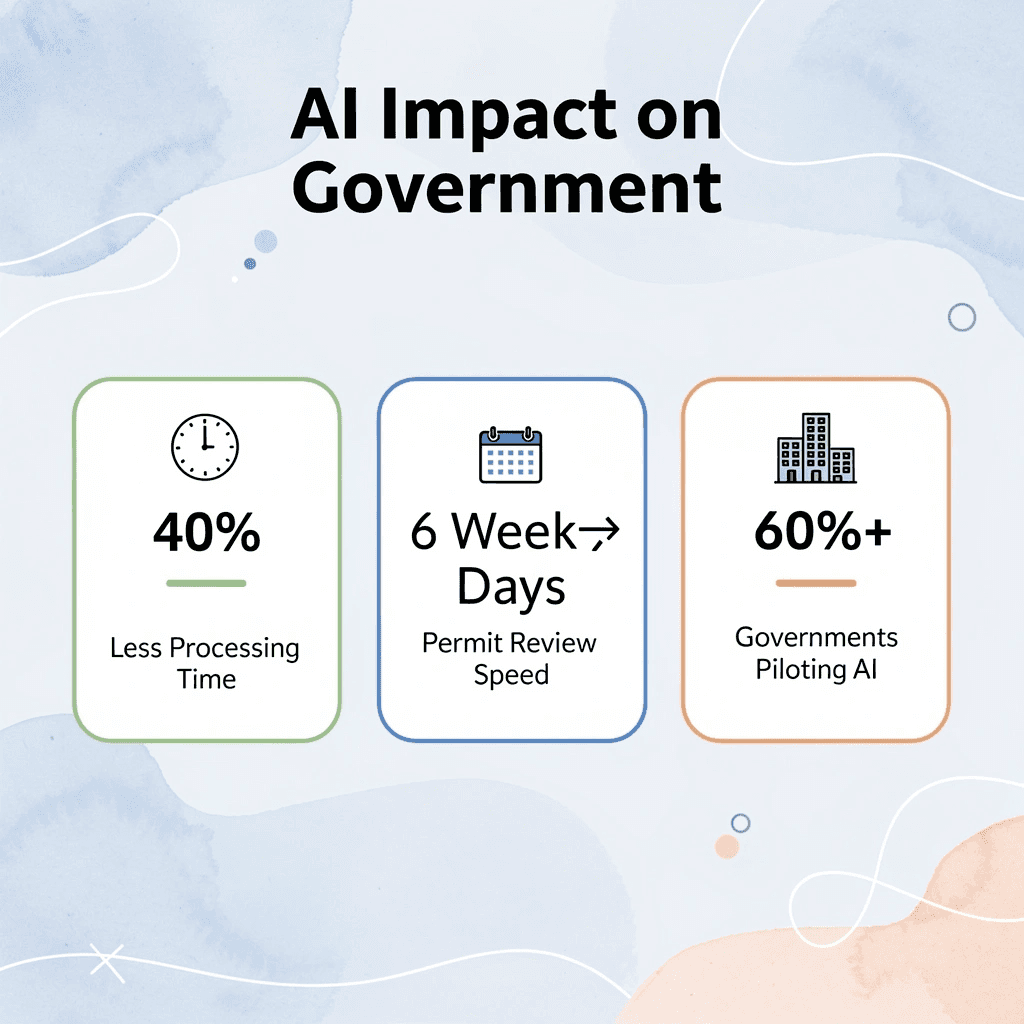
According to research published in PMC's peer-reviewed analysis of AI in government, AI-driven government services can reduce administrative processing time by up to 40%. When a permit review drops from six weeks to days, the agency reshapes its entire operating model: what it promises citizens, how it allocates staff, and what its backlog looks like by year-end.
"AI-driven government services can reduce administrative processing time by up to 40%, reshaping everything from citizen promises to year-end backlogs." — PMC Peer-Reviewed Analysis of AI in Government
🔑 Takeaway: A 40% reduction in processing time is a fundamental restructuring of how an agency operates, staffs, and delivers on its commitments.
Over 60% of governments globally have adopted or are actively piloting AI-based digital transformation initiatives. This is a field-wide shift in how public institutions approach service delivery, fraud prevention, and resource allocation. The agencies leading this shift figured out how to layer intelligence onto what they already have.
⚠️ Warning: With 60%+ of governments already moving, agencies that delay AI adoption risk falling behind on every dimension — speed, accuracy, and citizen trust.
AI Application Area |
Impact on Public Sector |
|---|---|
Service Delivery |
Faster processing, reduced backlogs |
Fraud Prevention |
Real-time detection at scale |
Resource Allocation |
Smarter staffing and budget decisions |
Permit & Admin Review |
Weeks reduced to days |
How do agencies deploy AI without replacing existing systems?
Successful deployments follow a consistent pattern: agencies connect existing systems rather than replace them. A machine-learning model trained on claims data doesn't need new database architecture to catch fraud—it needs access to transaction records already in place. A natural-language interface that answers citizen queries doesn't need a rebuilt contact center—it just needs to talk to the existing knowledge base. Most agencies have the raw material for transformation. The gap is the integration layer that makes that material useful in real time.
Most public sector technology teams handle AI adoption through isolated pilots: a chatbot here, a document classifier there, each disconnected from core workflows. The hidden cost is months spent rebuilding compliance guardrails from scratch for every use case. Platforms like CodeGiant address this directly, letting agencies build production-grade apps, APIs, agents, and automations on top of their existing stack, with built-in compliance from the start, so pilots reach production without bottlenecks.
What makes AI genuinely transformative in public sector digital transformation?
What makes AI transformative in government is that it makes existing investments smarter rather than obsolete. A legacy case management system processing thirty years of records becomes exponentially more valuable when a predictive model surfaces patterns across that history. The data was always there. The intelligence that acts on it changes outcomes. The question is not whether AI belongs in public sector transformation—that debate is settled. The harder question is how agencies deploy it reliably at scale without sacrificing governance for speed.
Related Reading
- As400 Modernization
- Enterprise Ai Governance
- Public Sector Digital Transformation
- Mendix Alternatives
- OutSystems Alternatives
- Appian Pricing
- Ai Agent Pricing
- Outsystems Vs Mendix
11 Best Practices for Public Sector Digital Transformation
Successful public sector digital transformation starts with strategy, not technology. Effective modernization focuses on citizen needs, strengthens data governance, invests in secure infrastructure, and continuously improves service delivery. The following best practices provide a framework for building digital government initiatives that deliver measurable results.
"Successful digital transformation in the public sector is never about the technology first — it's about the citizen outcomes, the governance structures, and the strategic vision that make lasting change possible."
🎯 Key Point: Digital transformation in government must begin with a clear strategy centered on citizen needs — technology is the tool, not the starting point.
💡 Tip: Before investing in any new platform or system, ensure your agency has defined measurable goals, established data governance policies, and mapped the end-to-end citizen journey you're aiming to improve.
Transformation Pillar |
What It Means |
Why It Matters |
|---|---|---|
Citizen-Centered Design |
Services built around user needs |
Drives adoption and satisfaction |
Data Governance |
Policies for data quality and access |
Ensures trust and compliance |
Secure Infrastructure |
Resilient, protected digital systems |
Protects public data and continuity |
Continuous Improvement |
Iterative service delivery refinement |
Delivers measurable, lasting results |

1. Anchor Every Initiative in Clear, Shared Outcomes
Define the exact results the program must deliver before selecting technology. The Institute for Government stresses that successful digital programs begin with measurable outcomes rather than a list of systems to build. Agencies that start with concrete targets—such as reducing permit processing time by a set percentage or eliminating repeated data entry—keep teams aligned, prevent scope creep, and enable progress measurement against real public value instead of technical milestones.
2. Secure Visible Executive Leadership and Accountability
Put digital transformation under senior leaders who own both the risks and decisions. Without top-level support, projects stall when priorities shift, or budgets tighten. The UK State of Digital Government Review and World Bank GovTech guidance both identify leadership as a root enabler: executives must treat digital performance as a core responsibility, reward it in performance reviews, and break down silos between technology teams and policy/operations.
3. Design Services Around Actual User Journeys
Map out the complete experience of citizens and staff before writing requirements or choosing tools. Agencies that skip this step create digital channels that force people to use multiple portals or repeat information. User research, service blueprints, and ongoing testing with real users ensure that new platforms reduce friction rather than merely digitize existing pain points, thereby increasing adoption rates and public trust.
4. Assemble Cross-Functional, Multidisciplinary Teams
Bring together policy, operations, data, design, and engineering specialists into permanent product teams that remain with the service after launch. Siloed teams hand off unfinished systems and lose critical knowledge about how things work. Cross-functional groups working in short cycles learn faster, solve problems at their source, and maintain services as living products.
5. Build Shared, Interoperable Platforms Across Government
Invest in common digital infrastructure—identity, payments, data exchange, and cloud foundations—that multiple agencies can reuse instead of building separate versions. The World Bank's GovTech Maturity Index highlights interoperability frameworks and whole-of-government approaches as essential for closing maturity gaps. Shared platforms reduce duplication, accelerate service launches, and establish the data foundation for advanced analytics and AI.
6. Modernize Legacy Systems Incrementally Rather Than All at Once
Replace or wrap old systems through controlled, step-by-step migration that keeps services running while new features come online. Completely replacing everything at once poses unacceptable risk and results in long outages. Agencies that pull out logic, map data, and convert modules in stages, using governed platforms that support secure public-sector modernization, reduce technical debt without disrupting citizens. Tools that let production-grade applications and agents sit atop existing stacks while maintaining full control and compliance accelerate this work and keep critical systems running throughout the transition.
7. Adopt Continuous Delivery and Automated Testing Practices
Move from large, infrequent releases to small, frequent deployments backed by automated testing, security scanning, and rollback capability. Continuous integration and delivery pipelines enable teams to ship improvements weekly or daily instead of waiting months or years. This shortens feedback loops, catches defects early, and maintains higher service reliability as systems grow more complex.
8. Invest Continuously in Digital Skills Across the Workforce
Give both specialist technologists and general civil servants the skills to design, use, and manage modern digital services. Training must cover data literacy, user-centered methods, AI tools, and secure development practices. Agencies that treat skills development as an ongoing operational requirement rather than one-time courses close the talent gap, reduce reliance on expensive contractors, and strengthen institutional knowledge.
9. Establish Strong Data Governance and Secure Sharing Rules
Create clear ownership, quality standards, privacy safeguards, and legal frameworks that allow data to flow safely across agencies while protecting citizens. Effective data governance transforms fragmented records into shared assets that support accurate decisions, proactive services, and trustworthy AI applications.
10. Align Funding Models to Support Continuous Improvement
Move money away from big projects that receive substantial initial funding but minimal ongoing support. Instead, plan for steady funding that covers regular maintenance, updates, and improvements to the platform. Digital services require continuous investment after launch to keep systems current, secure, and responsive to citizen needs.
11. Measure Progress with Outcome Metrics and Iterate Continuously
Track real results like citizen completion rates, processing times, cost per transaction, and staff time freed, rather than counting systems launched or lines of code delivered. Publish those metrics openly and adjust course when numbers fall short. Agencies that treat measurement as a permanent management discipline spot problems early, prove value to leadership, and keep transformation aligned with public benefit. Our CodeGiant enterprise AI platform helps teams move from prompt to production-grade applications, agents, and workflows while retaining full control and compliance, enabling continuous iteration on complex legacy estates.
How to Measure the Success of Public Sector Digital Transformation
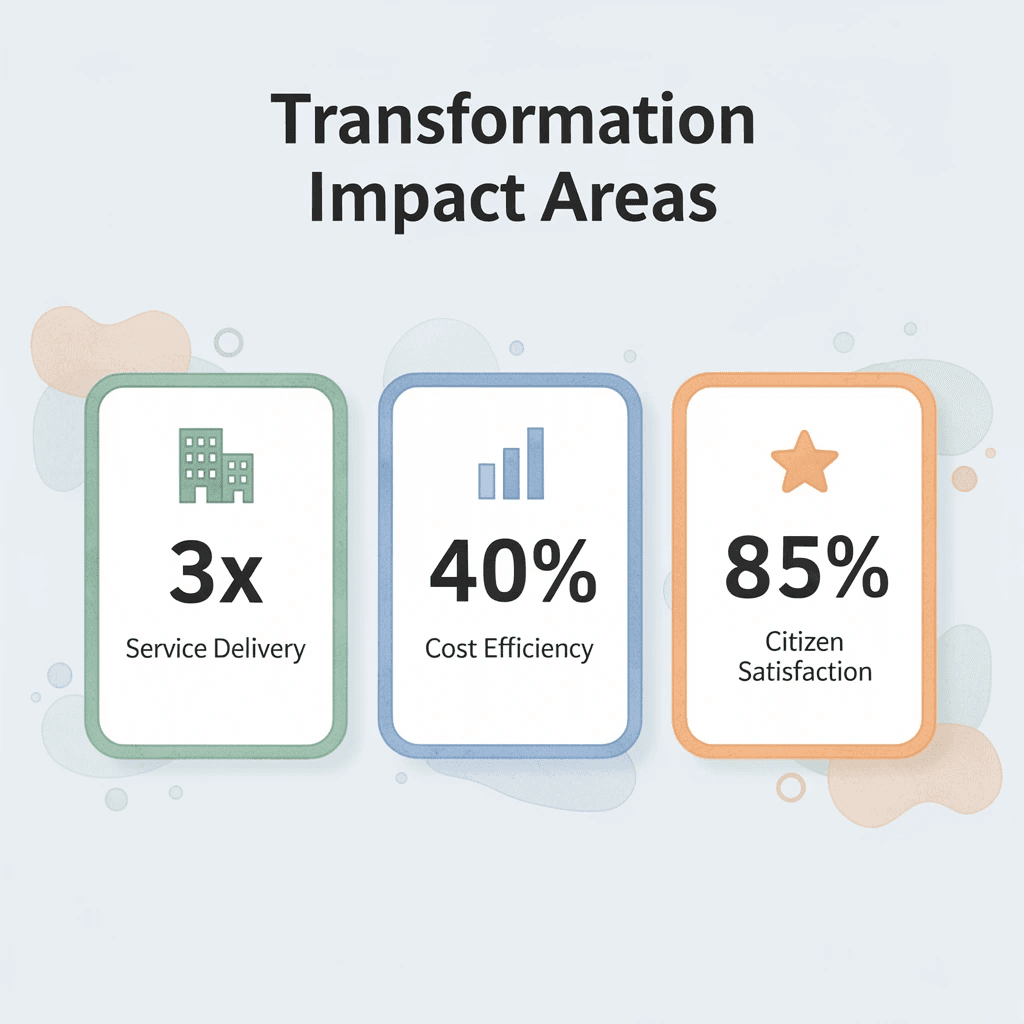
Public sector digital transformation succeeds when it produces measurable improvements for citizens, employees, and institutions. Clear performance indicators must demonstrate whether digital investments improve service delivery, increase operational efficiency, strengthen security, and build public trust. The following metrics provide a practical framework for evaluating long-term success.
"Digital transformation in the public sector is only as strong as the metrics used to measure it — without clear performance indicators, even the most ambitious initiatives risk losing direction and accountability." — Digital Governance Framework
💡 Tip: Start by aligning your performance indicators to specific citizen outcomes — not just internal IT milestones — to ensure your digital transformation delivers real public value.
⚠️ Warning: A common mistake is measuring digital transformation success purely by technology deployment rather than actual improvements in service delivery, efficiency, and public trust.
Measurement Area |
Key Focus |
Success Indicator |
|---|---|---|
Service Delivery |
Citizen-facing outcomes |
Faster, more accessible services |
Operational Efficiency |
Internal processes |
Reduced costs and processing times |
Security |
Data and system protection |
Fewer breaches, stronger compliance |
Public Trust |
Citizen confidence |
Higher satisfaction and engagement scores |
Track End-to-End Transaction Completion and Time Savings
The clearest sign of success is whether people complete the task they set out to do and how long it takes them. Agencies set starting points for digital versus paper or in-person channels, then measure the percentage of transactions started online that reach successful completion, average time from start to finish, and drop-off points. The Australian Digital Performance Standard recommends KPIs such as applications started versus completed, time spent on each step, and error rates that cause abandonment. Reductions in these times and rises in completion rates demonstrate that digital services remove friction rather than simply move the same process online.
Measure Citizen Experience and Effort
Capture how easy or difficult residents find the new services to use, using structured feedback and behavioral data. Customer Effort Score, satisfaction ratings after key transactions, and free-text comments reveal whether the digital channel feels simpler than the old process. Monitor traffic sources, device usage, and demographic patterns to confirm services reach intended populations without creating barriers. Improvements in these scores demonstrate that the transformation delivers real convenience.
Quantify Operational Efficiency and Cost Impact
Track the resources needed to deliver each service before and after digital changes. Key indicators include cost per transaction, staff hours freed from manual processing, volume of calls or letters avoided, and reduction in error-correction cycles. The UK State of Digital Government Review highlighted the scale of potential productivity gains from full digitization; agencies that measure realized savings against those projections prove the business case and free up capacity for higher-value work. System availability, mean time to restore after incidents, and the share of legacy systems retired demonstrate whether the underlying technology base has become more reliable and sustainable.
Assess Adoption, Uptake, and Channel Shift
Success requires citizens and staff to use new digital pathways. Agencies measure the proportion of service work completed digitally, growth in digital identity usage, and the decline of traditional channels. The World Bank GovTech Maturity Index tracks online public service delivery and digital citizen engagement across dozens of indicators, including portals, e-payments, and feedback platforms. When the digital share increases and satisfaction remains stable or improves, it demonstrates that new services meet citizen needs.
Align Metrics with Mission Outcomes and Maturity Frameworks
Connect every digital investment to the core functions the agency must perform and to recognized maturity models. Mission-essential function indicators show whether technology strengthens the agency's ability to deliver its statutory responsibilities under pressure. Frameworks such as the OECD Digital Government Index and the World Bank's four GTMI pillars (core systems, service delivery, citizen engagement, and enablers) provide structured benchmarks for comparison over time and against peers. Regular scoring against these frameworks transforms isolated project metrics into a coherent picture of institutional progress.
Monitor Equity, Inclusion, and Trust Indicators
Track completion rates and satisfaction by age, location, language, disability status, and device type. Measure the availability and effectiveness of assisted digital support. When digital exclusion declines and trust scores rise—such as confidence in secure data handling—it demonstrates that transformation expands access rather than excluding segments of the public.
How CodeGiant Accelerates Public Sector Digital Transformation
Moving from knowing AI works to actually using it reliably is where most government modernization efforts get stuck. The gap stems not from ambition or budget, but from the lack of a clear path from existing systems to production-grade capabilities without disrupting services that citizens depend on.
"The gap is not about ambition or budget — it's the lack of a clear path from legacy systems to production-grade AI capabilities without disrupting the services citizens rely on."
💡 Tip: The first step toward public sector AI adoption isn't a bigger budget — it's identifying a structured migration path that protects critical citizen-facing services during the transition.
🎯 Key Point: Government modernization stalls at the implementation layer: the bridge between proof-of-concept AI and reliable, production-ready deployment at scale.
Why do most public sector digital transformation efforts stall at deployment?
Most agencies treat modernization as replacement: identify the old system, budget for a new platform, plan the switch. The result is predictable—timelines that stretch for years, costs that exceed the budget, and difficult transitions in which neither system functions well. Staff lose confidence, services degrade, and the new platform still doesn't connect to the twelve surrounding systems.
How does building on existing infrastructure affect public-sector digital transformation outcomes?
The critical difference is to build on what already exists rather than discard it. According to MarketsandMarkets, the global digital transformation market is growing at 9.1% annually through 2031. Government agencies cannot afford to replace everything every three years when citizen expectations and security needs shift every three months. Agencies making progress treat existing infrastructure as valuable assets to improve, not broken systems to eliminate.
How does CodeGiant close the gap between experimentation and production?
Most teams move from AI pilot to production by adding new tools on top of manual governance: spreadsheet approvals, email sign-offs, and informal checklists. As services grow, this structure breaks down—audit trails fragment and compliance reviews slow deployment. CodeGiant generates production-grade applications, APIs, AI agents, and workflow automations that run within an agency's own infrastructure, preserving audit control and compliance from the first deployment rather than retrofitting governance afterward.
Where does public-sector digital transformation compound citizen-facing impact the fastest?
Workflow automation grows fastest when it helps citizens. When a permit application, benefits claim, or case review requires staff to manually transfer information among three systems, each step takes time and carries a risk of error. Automating that cross-agency handoff with built-in policy checks and audit trails saves staff time and improves the citizen's experience. According to a LinkedIn Pulse analysis on the future of public sector digital transformation, the global public sector digital transformation market is expected to reach $1.1 trillion by 2030, signaling that agencies now treat connected, automated service delivery as core infrastructure.
How does continuous delivery change the pace of public sector digital transformation?
The fastest-moving agencies build continuous delivery capability instead of treating each initiative as a standalone project. Daily or weekly iterations replace episodic, high-stakes release cycles. This shift from transformation as an event to transformation as a practice separates agencies that are still planning from those already serving citizens differently. The hardest question is not whether your agency can modernize, but whether the platform you choose will remain under your control when it matters most.
Related Reading
- Enterprise Architecture Modernization
- Rpg Modernization
- Iseries Modernization
- Application Modernization Benefits
- .net Modernization
- Application Modernization Roadmap
- Cobol Replacement
- Insurance Legacy Modernization
Try CodeGiant's Enterprise AI Platform Today
Having control over your infrastructure lets you deploy AI in a way that follows rules, connects old systems that still work, automates tasks, and offers public services that get better results. Our enterprise AI platform gives government technology teams a solid foundation to build production-grade applications, agents, and automations — deploying securely into AWS, Google Cloud, Azure, Oracle Cloud, or on-premises environments.
"A controlled infrastructure deployment means agencies can modernize without sacrificing compliance, legacy compatibility, or operational continuity." — CodeGiant Platform Overview
Deployment Environment |
Use Case |
|---|---|
AWS |
Scalable cloud-native government workloads |
Google Cloud |
Data analytics and AI model hosting |
Azure |
Microsoft-integrated agency systems |
Oracle Cloud |
Enterprise database and ERP workloads |
On-Premises |
Air-gapped or high-security environments |
🎯 Key Point: CodeGiant is specifically designed to support these complex, multi-environment deployments — giving your team the flexibility to build where it matters most.
⚡ Pro Tip: Don't force a single-cloud decision before you're ready. Multi-environment support means you can start where your agency is most comfortable and expand from there.

Move forward without replacing every system or putting your agency operations at risk with a single, high-stakes migration. CodeGiant meets you where you are, connects your existing infrastructure, and grows with what citizens expect, making modernization incremental, secure, and sustainable.
⚠️ Warning: A big-bang migration approach is one of the most common and most costly mistakes government technology teams make. Step-by-step modernization dramatically reduces risk and downtime.
✅ Best Practice: Request a demo today to see secure, step-by-step modernization in action within your own environment so your team can evaluate CodeGiant against your real infrastructure, not a generic sandbox.